Category Archives: Siding

Repair Notes: mallet locos 88290-88294

A very interesting Marklin Z loco of the ‘mallet’ type was introduced in 2004 as Insider Model 88290.

The class 96 loco has been released in 5 versions to this point in time, but Marklin did not limit the release of a ‘mallet’ type loco to this class, they also introduced the class 53 in 2007 as Insider Model 88053.

What characterizes a mallet locomotive is first an articulated frame along with two independent wheel sets. Invented by the Swiss engineer Anatole Mallet this type of locomotive was highly successful in mountain railways, and in the United States this loco type was used in coal trains. The articulated frame allowed for negotiating sharp turns while high and low pressure steam powered two sets of driving wheels. The front set of driving wheels form the ‘Bissell’ truck which received low pressure steam through a receiver after high pressure steam powered the second set of driving wheels first. Variations between European and American ‘mallet’ locos follow the basic design principle, but each varies by other factors including length and power. Marklin’s two mallet designs represent very large and powerful locos one of which never existed beyond blueprints as is the case with versions of the class 53: 88053, 88054, and 88055 (pictured).

To repair the mallet locos of class 96 some patience and practical experience in the repair of mini-club steam locos is required. Marklin Z steam locos have one set of driving wheels, the mallets have two sets and therefore one must treat each as independent by repairing one at a time. These are complicated locos, but they are so well designed that taking one apart and reassembling is relatively easy for those with some experience repairing locos with side rods. Note: wheels must be correctly orientated to allow free movement of side rods, side rods bow out when wheel sets are improperly installed in all locos with side rods.

This post came about rather by accident, I recently purchased an 88291 thereby completing my collection of this type loco, but it arrived with hardened oil syndrome which can be expected with dealer old stock. Tell tale signs of hardened oil syndrome are lights that work without a hum of motor or movement of wheels. The oil Marklin uses will harden over time which is compounded by improper storage. Hardened oil gums up the gears not allowing them to move, it looks like a crust, but it can also be sticky to the touch.

Note: white gunk near center of photo

To remove hardened oil a mild solvent is required, toothpicks work to loosen up crustiness and soaking NON PAINTED surfaces in “Original Windex” (blue). Improperly storing locos includes side down, they should always be stored wheels down. The one I just received was one such example of a loco stored long term on its side: hardened oil pooled on one side throughout gears and truck housings.

One can see the appearance of hardened oil as white crust, it can otherwise be fluid or congealed as a sticky substance all in the same loco: weird!

One gear is sometimes the culprit at least with this example. Part #226 646 is an interesting gear that sits mounted on a post cast into each truck frame of this loco, thus two are included in this design.

Note: gear can be seen mounted inside truck frame in two photos with yellow background

I have come across this gear on more than one occasion, Marklin’s class E 94 and 194 locos including all versions have this same gear in their design so repairing this loco is a good primer for repairing those. Time and time again it has been proven to me that if the German “krocodil” isn’t moving this gear is completely stuck due to hardened oil. Very careful attention needs to be applied to wriggle off this gear from its post, I use a toothpick over a dish to catch the part.

The transmission in this loco is very long with two worm gears, it comprises two extensions attached to the the tip of the motor (226 631).

So many parts that are required to move in the smallest space comprise a flawless design that includes a sensible tear-down and reassembly design.

Reassembly includes close adherents to correct order of things: no matter loco type small connecting gears always go in truck frame first followed by driving wheels.

Photo shows one truck’s correct assembly without oil pan attached. Note the two connecting gears which are standard with all locos in Marklin ‘Z’, and because they are small it is a good part to have spares of (part #226 645). Coupler and spring are not illustrated in photo, but they would be located on the right side. Side rods slide into black housing and only work one way: side rods of the third pair of wheels are orientated correctly in photo to allow correct distances in the truck mount for all gears. After coupler and spring are placed into their mount the oil pan slides over coupler end, and it is attached by a single screw.

It is always a good idea to keep an inventory of spare parts even though you may never need them because we are talking about the brilliant engineering and manufacturing by Marklin. That being said the motor for this series of locos is part #226 631, it is soldered directly to the pick-ups and solidly held in place to operate the very long transmission.

After each truck is cleaned, oiled and reassembled test it to make sure all gears move freely with the retaining pin and nylon gear installed too! Note: the nylon gear comprises two sets of teeth, one set engages with the worm gears on the transmission and the second is small running on one side of the nylon gear and engages with the post mounted gear previously mentioned. Recommendation: the nylon gear is another part to keep spares of, it is part #223 493.

Last note: if you know the loco is new and never run. And you have the loco taken apart, this maybe a good time to break in the motor and brushes independent of the motor’s engagement with the gears. Break-in: slow speed followed by medium speed, followed by high speed, and then reverse order. About 5 minutes of varying speeds will do.

Good luck and have fun!

Siding: required tools for repairing Marklin Z locos: pliers with micro tips, magnifying goggles, set of jewelers screwdrivers, foam work cradle, dish for holding parts, and guitar picks can be used to help remove plastic shells or shells without retaining screws.

BR 52: Marklin’s 8 versions in Z

German steam locomotive BR 52 for Deutsche Reichsbahn (DR) is the “Kriegslok” or war time locomotive. Germany intended to build 15,000 of these locos during wartime, but only 7000 were actually produced in car shops across Occupied Europe. The 2-10-0 wheel arrangement comprising small wheels allowed for heavy freight haulage on lightweight tracks. After the war the class 52 which was never intended as a long lasting locomotive design thrived in service in many countries after World War II, it is still claimed to be in service today (74 years as of 2016). The design of the locomotive included several operational as well as economic build characteristics including the fully enclosed cab which allowed a level of comfort in cold weather climates most notably for Germany’s incursion into Russia during the war, tenders that recycled exhaust steam back into water, and water tanks built frame-less to cut costs. The original BR 52 included smoke deflectors, but versions also existed without the deflectors as can be seen in Marklin’s mini-club versions.

BR 52 specs: wheel arrangement- 2-10-0, designer and builder- Hauptausschuss Schienenfahrzeuge, 1942 (1st one of approximately 7000 built), 2 cylinders/232 psi (boiler pressure)/ 55 inch wheel diameter, maximum speed 50 mph.

Marklin translated the BR 52 locomotive into 8 versions for Z including examples from Germany, France and Austria with examples from Era II-IV.

Marklin’s 8 versions include: 8883 (1996-1998) BR 052 DB, 88830 (2015) BR 52 DB, 88831 (1997-2003) BR 52 DB, 88832 (Insider-1997) BR 52 DRG, 88833 (1998) Serie 150 Y SNCF, 88834 (1999) BR 52 OBB Epoch III, 88835 (Insider-1999) BR 52 DB Epoch III, and 88836 (2001-2008) BR 52 DRG Epoch III.

88833: Serie 150 Y SNCF 88833_2

88834: BR 52 OBB  88834_2

88836: BR 52 DRG 88836_2

Siding: under repair notes see 5 pole motor upgrade for 88833 + 88834

Book Review: Koll’s Spezial Katalog 1996 + 1997

FullSizeRender-7FullSizeRender-5

 FullSizeRender-9

Pubicity wagens and locos are a particular sub-group category of collecting Marklin Z. Rolling stock, locos, and trainsets produced by Marklin through private commission date to nearly the beginning of Z with examples starting in 1975. Limited to 100, 200, 300 or 500 publicity wagens were always and only available through specialty dealers with few residing in the USA. Before Ebay one had to rely on a good dealer source for collecting these rare items, but today they become available every once in awhile due to increased internet connectivity with dealers and collectors who have these for sale. In 1996 and 1997 Koll’s assembled two concurrent and unique catalogs which archived the publicity cars up to and including 1997, they assigned their own numbering system since none had been provided by Marklin. Koll’s numbers are five digits, the first two on the left refer to date produced (example: 87 is 1987 and 90 is 1990) and the three numbers on right refer to chronological sequence for that year, but chronological numbers jump broadly an example from 1990 are cars ‘005’ to ‘701’, I have no explanation for why the numbers jump in this way only to explain that they follow from less value to greater value suggesting an order of production. The Koll’s catalogs ordered up an archive at a time when Marklin was not thus collectors could now research this category of collecting. And it is a rich category of collecting with numerous company logos printed on the sides of standard Marklin design cars: 8600, 8612, 8615, 8626, 8661, 8656 and others. No other reference exists like the Koll’s catalogs for this timeframe which includes edition size and illustrations. Another useful archive for this category is the chronological sequence by Gilles Monk of Belgium thus a second numbering system exists called the Miba/Monk Liste, but the Koll’s catalogs are much easier to use for research up to and including the year 1997.

Siding: Marklin Special Imprint 8656 Swiss Hbis cars are only covered in the 1997 Koll’s Spezial Katalog.

4th Quarter 2016 release of the new “Krokodil” – 88563

The Swiss ‘Krokodil’ in scale model railroading is identified more than any other as a ‘Marklin’ model, Marklin produces it in all scales, it appears in their marketing as much as the German equivalent class E94, and its continuous appearance in the Marklin Z catalog since 1979 further reinforces Marklin’s dedication to this prototype.

The articulated Swiss loco type is a fascination for all railroaders: train spotting or model collecting. As a model in ‘Z’ it faithfully reproduces the action of the dual set of side rod wheel sets found in the prototype.

As for its history in ‘Z’ we begin in 1979 with the 8856: green paint scheme presented in the original mini-club wood-grain box. Four versions of the 8856 were produced ending in 2010 with a 5 pole motor version.

The 8852 version in brown paint scheme was produced 1983 – 1990. One other individual release was the totally lovely 2013 Nuremberg Toy Fair 88561 in black paint scheme.

In various intervening years the Krokodil was sold in train sets starting with 8115 “125 Jahre Rotes Kreuz” set that commemorated the 125 year anniversary of the Red Cross in Switzerland. Other sets included the 81423 “Schweizer Guterverkehr” Swiss goods transport set and 81433 “KNIE” circus train set. Along came the unique set 88888 “150 Jahre Marklin”: deluxe illustrated carton with two Krokodil’s including one New York Central ‘fantasy’ loco in white with copper patinated color scheme on roof.

For the first time Marklin is offering some new features in this newly updated version with item number 88563. Updated features include LED’s, hidden catenary screw, new road number, and correct Swiss headlamp/marker light changeover. This Era II class Ce 6/8 III electric locomotive is scheduled for release at the end of 2016, it will be one of the big highlights in mini-club history for this loco type in 37 years.

Marklin has this listed as a “limited run.”

Siding: early ‘Krokodil’s” with 3 pole motors can be upgraded with 5 pole motor part #211904.

Marklin train set 81411: BR V 31 loco and hoppers

The 81411 train set was released as a 1997 One Time Series by Marklin for their MHI Program thus finding itself on the cusp of the future transition to the 5 pole motor. No fear the 5 pole motor upgrade is easy with this locomotive type: part number is E211903. Locomotive comes with 4 hinged roof hoppers for the transport of limestone these cars are classified as Tds Seitenentladewagens with various road numbers. Here is a train set that features weathering, one of the few I might add, but this weathering is lightly applied around the hinged roof covers in the form of lime dust. The weathering appears to have been applied with an airbrush in a separate application over the printing: very good! Attractive train sets are abundant in Marklin Z, but one cannot have enough! I like this set very much, it worked great right out of the box with the original 3 pole motor, but I opted for upgrading to 5 pole which was very easy to do. Motor upgrades are pretty easy on locos without side rods with few exceptions including multi unit sets. Great detail and color plus the less common “Lollo” locomotive make this a great set to add to a collection. At least the color of the loco and its type make it different than everything else.

_DSF9720

81411- HEG train set that includes loco and 4 hinged roof hoppers with light weathering, MHI One Time Series 1997.

Siding: Original 3 pole motor can be upgraded to 5 pole with part #E211903.

Marklin weathering: experts in Z!

Marklin has released ‘weathered’ rolling stock before, but the weathering on a current release of 10 cars is so good it deserves special praise. Those 10 cars are none other than the GI 11 boxcars for the DB in three versions: 82175- 82178 type GI 11 without hand brake, 82261- 82263 type GI 11 with brakeman’s cabin, and 82264- 82266 type GI 11 with brakeman’s platform. In 2014 Marklin released these same cars lettered for the DB in a 10 set pack without weathering, they showed off Marklin’s excellence in injection molded plastic; you can see all the bolts and planks that built the prototype along with crisp lettering throughout: car set 82559 is long sold out but some are still available from some of the Ebay listed dealers. The 10 individual cars this post is dedicated to is currently out of production (short shelf life for these beauties!!!), but Walthers still has them in stock! The weathering is coal soot from the loco and other floating dust and grime from many miles traveling the rails. Authentic to the prototype, this weathering is applied to the lower extremities of the cars in varying thickness and spread: no two are the same! I would to see more of Marklin’s obvious weathering skills applied to other locos and rolling stock thus making the world one step closer to being complete and true! Bravo to Marklin!

_DSF9697

Three car types from set 82559 side by side with the newly released heavily weathered same car types.

Siding: wheel sets are also complemented with authentic weathering. Wheel sets from Marklin Z rolling stock can be similarly weathered and aged using an airbrush with water based pigment, they simply unclip from the chassis, hold them in place and give each a light swipe from the airbrush gun!

“Lollo” that’s the name! or BR V 160 for sure!

“Lollo” is the cutest nickname for a hardworking diesel locomotive, but what’s in the name? The loco was nicknamed “Lollo” as an apparent allusion to the actress Gina Lollobrigida and because of the apparent shapely front end of the loco (?). After a quick google search, I told my Wife about the nickname given to this loco, my Wife rolled her eyes when hearing that a loco would be named after an Italian sex symbol; one wonders what else is named ‘Lollo”?

Thus far to the best of my knowledge Marklin has produced 4 variations of the V 160: 3 individual releases and 1 with a train set. Note: two of these locos were renamed in 1968 following Germany’s new classification thus they are technically BR 216’s.

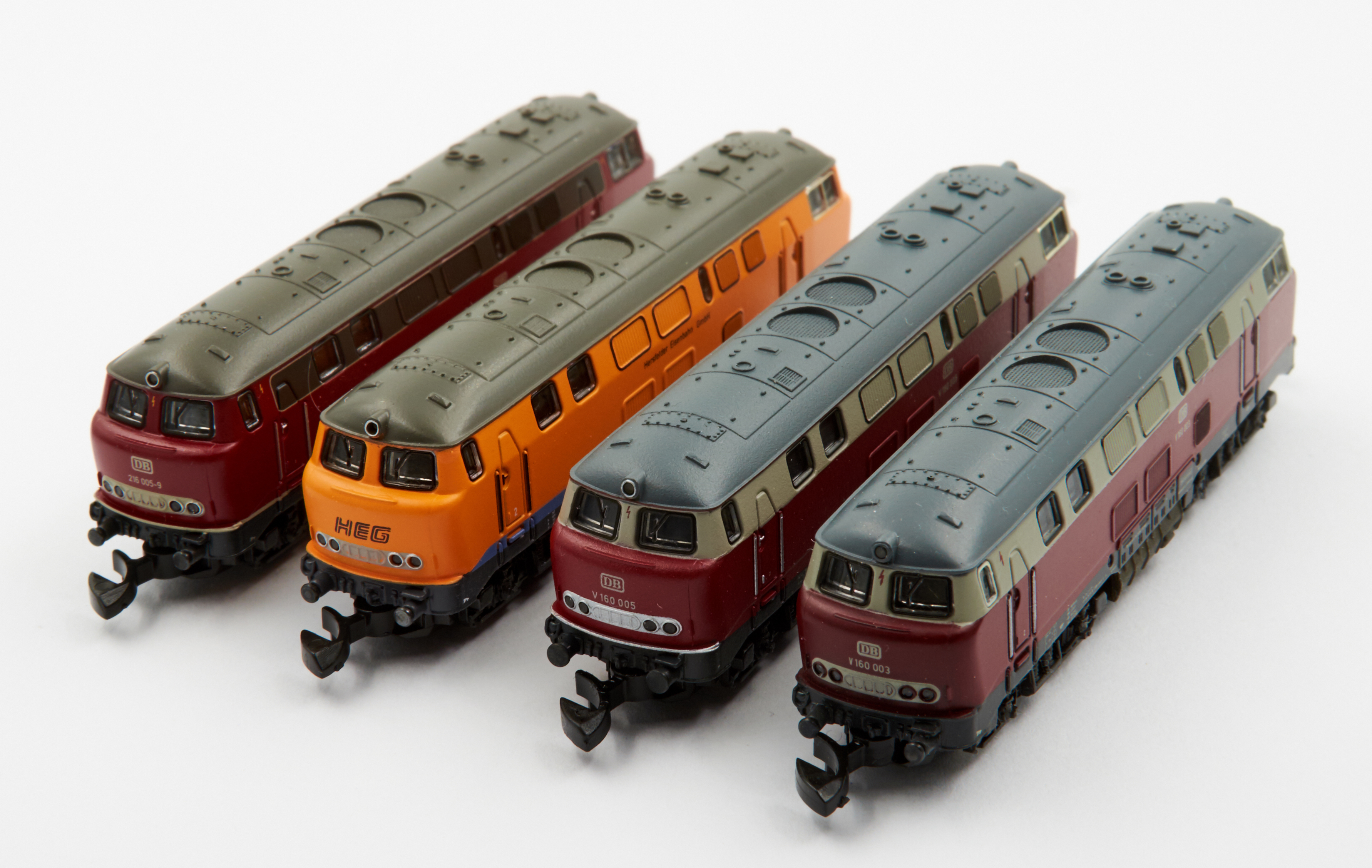
_DSF9618

from top:

  1. 8866- German Federal Railroad (DB) BR V 160 pre-production general purpose diesel locomotive. Operating number V 160 003. Era III (1962). Originally sold with 3 pole motor. Build date: 1990-1994.
  2. 88785- German Federal Railroad (DB) BR V 160 pre-production general purpose diesel locomotive. Operating number V 160 005. Era III (1962). Current catalog.
  3. 88782- German Federal Railroad (DB) BR 216 005-9 former BR V 160 reclassified in 1968 as BR 216. Operating number 216 005-9. Build date: 2005-2008.
  4. 81411- HEG – Hersfelder Eisenbahn GmbH privately owned former BR 216, operating number BR V 31. Sold as part of train set 81411 which included loco and 4 hinged roof hoppers. Originally sold with 3 pole motor. Build date: 1997. One Time Series for MHI (Marklin Handlers Initiative).

_DSF9728

Photo: the new “Lollo” with bright new grill is second from right!!!

*Note: LED’s on all these locos with warm white and red lamps that change over with direction of travel. Great feature found on all versions of this loco type even with the early ones!!!!! And they are superb runners!

Siding 1: 8866 and 81411 can be upgraded with E211903 5 pole motor.

Siding 2: check out the cool elliptical window that disappeared following modifications to the V 160.

Siding 3: In 1968 the V 160 was reclassified as BR 216, V 162 became BR 217 and V 164 was reclassified BR 218. A very informative Wikipedia page is dedicated to the V 160 that fans should check out.

What was once is here again: 8866 + 88785

The ‘pre-production’ 1962 BR V 160 “Lollo” was released as Marklin 8866 in 1990-1994, here it is again as 88785 with the recent release. Class 160 was an important locomotive development in Germany thereby creating a successor to steam unmatched by other locos at the time. Germany’s new classification of 1968 renamed it BR 216, by then it had also undergone a transformation which will be presented in other posts.

_DSF9612

from top:

8866- German Federal Railroad (DB) BR V 160 pre-production general use diesel locomotive. Operating number V 160 003. Build date: 1990-1994.

88785- German Federal Railroad (DB) BR V 160 pre-production general use diesel locomotive. Operating number V 160 005. Build date: current catalog.

Variations in the Marklin models are subtle:  Paint maybe a little brighter (?) on 88785, door numbering is smaller on 88785, frame no longer says ‘Made in West Germany’, electrical equipment insignia has been removed from side panels on 88785, door latches painted on 88785, bright silver grills on 88785, different operating numbers, wheels darkened on 88785, and 5 pole motor is standard with 88785.


Siding 1: 8866 can be easily upgraded with 5 pole motor #E211903.

Siding 2: All variations of V160, BR 216 and BR 218 have always used LED’s thus warm white and red lamps that change over with direction.

Marklin 5 Pole Motors

Marklin 5 pole motors have been around for awhile, they were introduced in 1999 with the release of the DB class 143 loco #88431. The 88431 release made no mention of this new motor, but it was soon found out and happily too! The 5 pole has been the standard motor for all locos since, but it is important to mention the 3 pole was a record setter and powerhouse. Marklin makes available 5 pole motors for older locos, should the conversion be made? Brushes have become hard to come by for 3 poles which helps to sway the decision for converting to 5 pole, and your loco with the 5 pole will be more responsive at slow idling and quieter. The price of 5 pole motors varies greatly and availability has become less and less; Walthers lists several motor types as ‘sold out.’ Ebay is a good source when your dealer cannot provide them.

The following is a picture guide of five mini-club motors I use:

_DSF9601  E211903 is installed in most Marklin Z locos by far (SBB 460’s, American F7’s, VT 11.5’s and more), it features two standard gears at opposite ends of the armature.

_DSF9599 E209452 features worm gear both sides, it is used in all railbuses. Note: motor sold without brushes. This is the only Marklin Z 5 pole motor produced in Germany all others are China.

_DSF9600 E211914 features gear on one side, it is used for one purpose: replaces 3 pole motor in 8998 turntable. *See my blog on making this repair. Note: 5 pole motor is available for 8994 transfer table.

_DSF9598 E211904 features worm drive gearing on both ends, it used in 8856 and 8852 ‘Krokodil’s’.

_DSF9597 E211905 features worm drive gearing on both ends, it is used in BR 144’s such as 8825.

Siding 1: The very successful class 143 electric loco was developed in East Germany as class 243. Marklin’s interpretation of the prototype includes the DR version as well as DB versions with LED’s and superb detailing. The current 88435 is one such example of a privately owned class 143 lettered for RBH Logistics GmgH.

Siding 2: Before installing a new 5 pole motor run it in both directions to break-in brushes. A common reason locos don’t run after 5 pole motor installation is likely due to circuit board whiskers not making contact with capacitor.

Marklin 8873: Tales of HOS!?!?!?

I just received the original Marklin TEE VT 11.5 train set 8873 and matching coach set 8793 from a dealer’s old inventory. For a train set that has been stored for almost 20 years and probably on its side I expected HOS (hardened oil syndrome), I wasn’t disappointed! Not only did the trucks not move freely, but the loco shells were cemented onto the chassis. With gentle nudging on each side of the shell I was able to eventually work them free, but the window glazings came too! Typically HOS is evidenced by an opaque tan clay like substance from the oil drying out, but this time it was an all over clear residue that even leaked onto the outer chassis thereby gluing the window glazing tight to it. The motors were even glued to the chassis frame thus began the repair and restoration work that started with soaking all unpainted surfaces in a mild solvent otherwise known to this blog as ‘Original’ Windex (blue) followed by the pain staking process of using no scratch toothpicks to gently loosen the rough crust of old dried up oil. Usually bringing back an old Marklin Z loco is straight forward and easy, but this time was very unusual due in part to too much of the wrong oil used and then long term storage on its side. Patience is expressly stated for the best results and lots of toothpicks. After moving points are cleaned up use new Labelle oil (viscosity for Z only) sparingly and enjoy the fruits of your labors. Window glazing was reattached using 5 minute epoxy. *Use only 5 minute epoxy when reattaching plastic parts, it is the only glue for tough durable repairs that don’t damage plastic. ****Avoid plastic cements like Faller ‘Expert’, they will melt your loco and coaches.*****************

Siding 1: The shells of both end units on all VT 11.5’s and versions should easily slide off using gently pressure with a small screwdriver placed in the car end located in the coupling hole (*remember to remove coupler before attempting to remove shell) if it is sluggish work both sides with very gentle pressure to avoid cracking or marking shell housing.

Siding 2: 8873 greatly benefits from upgrading the original 3 pole motor to the new E211903 5 pole motor. Because each end unit is powered this train set will require 2 motors with an approximate cost of $100 total, but you can sell the old motors on Ebay for $20 each.

Siding 3: Store your Marklin Z locos on their wheels otherwise the oil will pool inside the loco and not out the bottom. This is an important rule for long term storage.