Category Archives: American Prototypes

Once Upon a Time: Building Kits in Z Gauge

GC Laser #59025 Lindsay Bros. Entry Backdrop + Marklin 88625 (class E8A)

I am starting a new series of posts examining older (some very old) building kits for Z gauge partly inspired by a gift of a friend: great variety of Z gauge building kits from the 80’s and 90’s. Already this part of the Z gauge history is now 25-35 years ago which astounds me, where has the time gone; my old vintage Marklin Z locos and rolling stock are now like old friends. Scenery went through an evolution in this timeframe just as trains did.

C Laser #59025 Lindsay Bros. Entry Backdrop

American manufacturers of building kits were small and larger but still small compared to German makers. A great variety of kits included paper, wood and plastic: cast, laser and photo etched.

C Laser #59025 Lindsay Bros. Entry Backdrop

In the mix is this first kit by GC Laser a known manufacturer for Z gauge buildings: #59025 Lindsay Bros. Entry Backdrop. This is a space saving backdrop building featuring a beautifully detailed facade. Constructed of laser cut cardboard and wood, kit features parts that are glued to both sides of a 3/16″ piece of wood. Very quick and easy to assemble with blackout paper attached as the final step. No need to paint this building due to very realistic color and detail.

C Laser #59025 Lindsay Bros. Entry Backdrop

Footprint: 3 3/8 ” (length) x 3 1/16″ (height) x 5/8″ (depth including sidewalk). Signage is very attractive, but does not appear to refer to an actual business based on Google search for this post.

I will be posting other early kits in the next few weeks as I build them to show and review. Thanks for looking and Happy Railroading.

AMTRAK Class E8A Diesel Locomotive: Marklin 88625

Marklin 88625 Class E8A Diesel Locomotive (collaborative project with AZL)

Marklin’s collaborative project with AZL has included 4 class E8 and E9 diesel locomotives: and now 5 with the release of 88625 (announced 2023).

Marklin 88625 Class E8A Diesel Locomotive (collaborative project with AZL)

Announced for the first time in 2014, Marklin released Pennsylvania Railroad class E8A (88629), and 2 Export Models: Southern Pacific class E9 (88628) and Union Pacific class E8A (88627). Announced in 2015, Union Pacific E8B (88626) was not issued as an ‘Export’ Model, but it was likely produced in similar numbers to the UP E8A (88627).

Marklin 88625 Class E8A Diesel Locomotive (collaborative project with AZL)

Class E8A painted and lettered for AMTRAK varies from earlier releases including white carton with printed article number. It should be pointed out earlier releases of the E8 and E9 were presented in black boxes with printed article numbers stuck on boxes.

Marklin 88625 Class E8A Diesel Locomotive (collaborative project with AZL)

Design and motive power is identical with all locomotives in this article: split die cast frame is a particularly good feature as it allows superior tractive effort. Also traction tires installed on one wheel of each wheel set. The locomotives are each delivered with an extra wheel set, locomotives released before 88625 included extra wheel set without Marklin coupler installed: spring, coupler, and coupler hook is a separate part included in box. Marklin 88625 is delivered with Marklin coupler installed wheel set which is not prototypical in appearance as it ruins the sweeping aerodynamic lines of the loco.

Marklin 88625 Class E8A Diesel Locomotive (collaborative project with AZL)

To change out the front wheel set follow instructions included with model. Takes just a few minutes starting with Step1: removing shell (I use same method for all plastic shell removals): wiggle 2 very soft flexible guitar picks near wheel sets, shell should pop off without being damaged. Step 2 pull off black section (fuel tank) to expose screw (3 screws hold frame together). Step 3 loosen/remove screw at wheel set you want to remove and loosen center screw (no need to remove). Step 4 using a slotted screwdriver carefully pry apart frame just enough to remove wheel set. Step 5 save as much grease from original wheel set to apply to new wheel set. Step 6 place new wheel set in place and retighten screws (check wheel set moves freely from side to side before continuing). Step 7 install Part #6 from parts list (Rail Guard), prongs on part #6 slide into holes on end of locomotive frame/assembly (this is not a snug fit, it will be loose). Note: part #6 on parts diagram shows coupler installed in part #6, mine was delivered unglued thus it does not stay in place. Note: it is recommended to use 5 minute epoxy versus Super Glue cementing plastic parts (Super Glue will deform and melt plastic parts). Step 8 install shell which will fit snugly and hold Part #6 (rail guard) in place.

Marklin E8A, E8B and E9 incorporate AZL’s split frame and motive power design
3 screws secure split frame: removal of fuel tank reveals center screw
wheel sets make contact with electrical contact strip running thru frame
each wheel set includes 1 traction tire

A couple of more differences to point out: 88625 is MADE IN GERMANY, it includes sticker on box, previous releases were made in China. Air horns on roof of locomotive (88625) are bundled together, formerly the horns included 2 as individual add-on parts this tooling change appears to have taken into consideration prototypical accuracy.

A locomotive with very good detail, heavy construction and smooth operation: highly recommended. Overall a very good Z gauge locomotive, but I would suggest an improvement would be lighted number boards (?).

Freudenreich Feinwerktechnik: Lehigh Valley Railroad Train Set

Readers of ztrainsweekly know of my interest in FR’s (Harald Freudenreich) Z gauge model trains thru many posts since its start. Lately the brand known as FR Freudenreich Feinwerktechnik is today Atelier Barkvieren. Over the course of its beginnings in the early 90’s FR’s contribution to the hobby includes just over 800 items, its history and reputation rooted in highly precise prototypical accuracy and flawless design + manufacturing. I thought it would be interesting to look back at a model train set produced in 1994 by Harald Freudenreich, and the fourth item ever to be produced in Z by FR.

Known as article number ZF004, it was preceded by 3 other train sets all from 1994 (numbered respectively ZF001-003). Today the discussion is about ZF004 train set painted and lettered for Lehigh Valley Railroad (1846-1976).

Train set ZF004 (1994) limited to 50 sets included a AGEIR boxcab diesel locomotive and 3- 31′ fishbelly hoppers painted and lettered ‘LEHIGH.’ Locomotive is constructed of metal with maintenance free motor similar to ones used by Marklin today. Locomotive is heavy as it appears to be entirely made of metal including truck frames and brass securing screws. Add-on parts include roof details: brass bell and smokestack. A curious characteristic about the loco are the non-rotating wheel sets, but loco’s short wheelbase allow it to negotiate curves perfectly, plus each truck includes pair of freely turning wheels without flanges thus locomotive includes 2 sets of driving wheels and 2 sets of un-powered wheel sets. FR’s distinctive coupler design was already used on their first locomotives as they are unchanged to this day. Couplers comprise simple bent wire hooks which couple easily with Marklin mini-club couplers, they also do not detract from the locomotives prototypical appearance.

Hoppers are constructed of mostly metal with fine detailing, each features prototypical couplers except for lead hopper numbered 25617, it includes a Marklin coupler at one end to pair with simple wire hook style coupler on locomotive. Hoppers appear to have 2 add-on parts: handbrake and platform by handbrake. On the underside: truss supports and coal funnels appear to be cast plastic cemented in place. Wheels are black plastic with each wheel set attached to car with brass screws. Each hopper features sharp lettering with smallest lettering perfectly legible with magnifying glass. Hoppers numbered: 25617, 25322, and 25039.

Train set was delivered in wood display box as was 4 other train sets in 1994. Display box is lined in silk and features metal ‘FR’ logo. Wood display boxes were used over the years by FR each lined with silk. This set as I bought it does not have additional items such as descriptive booklet, I am doubtful one was included. The presentation elevates this train set to the ‘expensive’ item category which in 1994 carried a price tag of 875 Deutsche Marks.

Siding: What’s in a name? ALCO Boxcab diesel locomotive was a diesel/electric switching locomotive referred to as AGEIR Boxcab’s so named after an amalgamation of the 3 builders of this locomotive class: ALCO (American Locomotive Company), General Electric and Ingersoll Rand.

Westmodel Z Gauge Saddle Tank Locomotive

My interest in Westmodel is new and old, I recently acquired my first models just weeks ago; they came from a dealer’s personal collection who lost track of their history. I’ve known about the company for many years, but I never had the opportunity to see a model in person. This post attempts to shed light on these amazing models from the now shuttered company Westmodel.

Few details sourced on the internet suggest Westmodel operated in Vienna, Austria (since 1973), its owner Klaus Bachmann produced model trains in various scales including: HO, HOe, HOm, N, Nm, and Z. Constructed of brass, locomotives were built with motive parts by Fleischmann and Marklin; my models include Marklin Z wheelsets. Today’s feature model utilizes a Marklin mini-club motor, frame and wheel sets. My research into the company is limited to web search which I hope is mostly accurate, I will revise/correct my Westmodel posts when new information becomes available. Interpreting the lineage of Westmodel is difficult, but they appear to have changed hands and moved over the years. Linie 8 GmbH was the last company to handle Westmodel articles as parts only (finished models were not available). In 2017 Linie 8 GmbH was liquidated. Errors in this history will be corrected as new details emerge through further research.

This post covers Westmodel #30062 for Z gauge: Saddle Tank Engine 0-6-0. Shell is constructed of brass with add-on parts including railings on water tank. Painted and lettered for “Lumber Co.” Interesting locomotive type is one of a kind in Z gauge: “tender-less” locomotive features water tank installed above boiler.

The model includes cast brass shell installed on Marklin mini-club locomotive frame with Marklin couplers, motor and wheels. Printed lettering on loco also features non-working headlights and shiny silver wheels. Best guess for date of manufacture is mid 1980’s or later. Westmodel articles in this scale were delivered in foam lined wood boxes with logo burned/stamped on lid.

After applying a little oil the locomotive operated flawlessly after an unknown time in storage. The locomotive’s considerable weight make it a good pulling locomotive for multiple cars loaded with logs and lumber.

Stayed tuned: future Westmodel posts will include N scale narrow gauge models featuring Marklin ‘Z’ wheel sets.

Happy Railroading!

Archistories American Prototype: 101181 “Goldtree Station”

If it is possible to visit a late 19th century western United States town built by gold perhaps this station in its small dimensions satisfies that goal. Measuring 5 inches in length x 2 1/2 inches in overall width x 2 inches in height the “Goldtree Station” by Archistories is the fictional hub and gatekeeper for the outside world, it greeted new comers with grand dreams of making it rich and goods to keep a decidedly inhospitable landscape habitable.

This year marks the important anniversary of the Transcontinental Railroad: 150 years East and West coasts joined by rails at Promontory Point, Utah. And a good time to consider modeling a western gold rush community in Z starting with this nice building exclusively sold by ZScaleHobo.com. And Marklin’s “Bumble Bee” locomotive and its passenger set from a few years back are a good train set for this station.

A fairly simple to build kit featuring partition walls which aid in realistic lighting effects, filigree parts which add realism to platform supports, and a mix of building materials including terracotta roof tiles and wood construction.

Goldtree station signage is laser cut with an appropriate American style font of the 19th century.

Railroads grew quickly after completion of the Transcontinental Railroad as did towns throughout the United States. Station and depot types changed too thus small stations with attached freight depots largely disappeared in the teens and 20’s, they were replaced by masonry structures supporting a network of hubs as people and goods were transported all over the United States. Towns who’s singular purpose supported the gold rush either grew independent of it or largely ceased to exist.


Note: exclusive worldwide dealer for this item is Zscalehobo.com

Construction notes: the ingenious feature of this Archistories kit are snap-in window frames and glazing, pre-cut glazing snap into place with gentle pressure followed by window frames, filigree timber sections are finally glued in place and permanently seal windows. Open freight doors are possible but interior detailing will need to be designed by the builder. *use glue sparingly and use great patience with light paper parts which cannot be realigned after gluing, plus snap-in window frames are prone to easy breakage, fraying and distortion.

Another important construction note: Part F10 is a delicate filigree part comprising the main entrance framework, after removing this part from the part sheet two more tabs need to be removed from either side of door frame: brackets should be flush to the structure. In my interpretation of this building it was missed thus reflected in the photos. A second important point is to install the 4 brackets (Part H4) for freight room before attaching roof.

Marklin 88035- Denver & Rio Grande Western Railroad 2-6-0 “Mogul” locomotive featuring brass construction (2004-2006)

UP + SP E8’s: joint collaboration Marklin/AZL

Marklin 88627
Marklin 88626 (only 46 prototypes were produced of the E8 ‘B’ unit)
Marklin 88628

The post war General Motors E8 diesel locomotive was built by their Electro Motive Division (EMD) in Illinois, it boasted a power reserve of 2250 hp for passenger service. Some units remained in service into the late 70’s pulling freight trains. Significantly longer than the F7 with significantly fewer produced than the latter, the E8 was designed with 2 – 6 axle trucks with 450 ‘A’ units produced versus more than 2000 F7 ‘A’ units.

Several prototypes were modeled in Z for the PRR, UP and SP railroads as a joint venture between Marklin and AZL, but aside from Marklin trucks/couplers and box the collaboration seems limited in scope with majority partnering coming from AZL.

Crisp graphics and accurate paint schemes plus detailed shells and trucks are equaled by what’s inside: heavy ballasting and robust brush-less motor.

Taking a look inside these locomotives reveal several unique design features of AZL versus Marklin including a heavily ballasted two-part frame. Holding the frame together are 3 pairs of phillips head screws which all but conceals the motor and transmission except for the circuit board which rests on top.

partial disassembly of E8 ‘A’ unit with showing skirting replacement part and extra truck included with loco

Servicing either of the trucks requires popping off the fuel tank thus revealing the middle set of screws: loosen only. Service one truck at a time by removing its designated pair of screws followed by gently prying the frame apart thereby allowing the truck to pop out. Repeat for other truck and test on track before reattaching fuel tank cover and shell.

one end of frame slightly pried apart allowing removal of truck, worm gear and pick-ups run length of frame
fuel tank and truck removed from frame, truck is held in frame within the recess in frame’s casting, two sides of frame secured with screws closes the space around top of truck frame thus securing in place
1 traction tire per truck and 2 powered axles per truck
locomotives come with Marklin couplers installed which can be replaced with provided skirting, also included is an extra truck, photo shows location of 3 screws per each side of frame
circuit board and LED light panel at one end are visible without shell, photo shows correct gap between two frame sides, drive mechanism is held within frame

Note: AZL gearing is comprised of nylon gears versus Marklin machined metal gearing, and AZL factory lubrication is grease versus oil.

brass worm gear and plastic skirting mount at frame end, frame is pried apart to allow truck removal

A full disassembly of the chassis and motor entails removing all 6 screws that hold the frame together with all components smartly fitted within. It should be noted that proper assembly of the frame leaves a consistent gap between the two sides: two frame sides do not touch. Transmission is properly fitted with plastic intermediary part positioned with prong ends down and engaged with holes in frame. Parts comprising motor and transmission must be seated properly for reassembly of frame, it is very important not to force these parts together.

truck gearing is permanently installed versus the take apart nature of Marklin trucks
inside and outside view of frame sides: worm gears held in place with nylon guides seated prong side down in designated holes
Inside view of the frame sides reveals a straightforward design concept
underside of frame shows normal gap between frame sides

The 3 ‘A’ units come equipped with prototypical skirting to replace the Marklin coupler which is simply installed following removal of shell, un-clipping coupler and spring, and sliding new skirting part with prong ends into frame recepticle.

LED light panel sits in slot with skirting bracket held in place with pressure from frame sides
skirting bracket is a two outlet plug which accepts the 2 prongs from the replacement skirting part, coupler is held in place with a removable metal clip otherwise the coupler includes the Marklin style coupler and spring, LED light panel is seen at the top of the frame assembly held in place with a designated slot
unique removable metal clip system for the coupler otherwise a normal Marklin set-up

Pulling power is further improved with traction tires which in combination with the heavy cast metal frame evenly distributed across the wheels ensure smooth operation. No need at all for adding extra weight to these locos!

Roof equipment varies between the prototypes thus the models reflect prototypical accuracy.

roof equipment varies between the locomotives

Very impressive locomotives from the stand point of aesthetics and performance unfortunately the installed Marklin couplers do not allow use of the only appropriate coaches produced by AZL. Maybe coaches are in development?

Siding: Marklin 88629 (PRR) is the fourth locomotive in this series


Excursion: The Milwaukee Road Heritage Center

The Milwaukee Road Heritage Center in Montevideo, MN is a railroad museum dedicated to the history and preservation of the The Milwaukee Road:

https://www.montevideomrhc.org/about.php

My Wife and I passed through Montevideo about 5 years ago which was our first visit in the yard of the Heritage Center. No fence or people were present on that visit, it largely looked abandoned, our guess for many of years? But we were drawn to the site after seeing the dome ends of two Hiawatha sky-top coaches or should I more aptly describe as the barebones framework of the signature sky-top cars unmistakable from Montevideo’s main street.

Just this August we were in the neighborhood and decided to stop; we hoped to see if any progress was made in the 5 years since the last visit. This time we were greeted by the friendly and knowledgeable Director of the Heritage Center who also gave us a complete tour of the site lasting 3 hours: what a treat! And boy oh’boy what a difference 5 years has made to this unique railroad museum with a growing and already impressive collection of coaches, MOW vehicles, locomotive switcher, turntable, station, loco shed, sanding facility, and museum quality working HO layout which displays the working yards of Montevideo in the glory years of The Milwaukee Road.

Max Hinde, Director of the Milwaukee Road Heritage Center stands adjacent to the train station in Montevideo, Minnesota. Housed in the station is a very large collection of Milwaukee Road artifacts, photographs, and station masters’ office complemented with all the essential equipment. Max is ‘tops’ in my book for remarkable practical expertise with all the railroad equipment and historical knowledge.

Not much progress has been made with the sky-top domes, the museum is currently looking for a qualified welder: the plan includes modifying a coach in the collection. ‘Wishful thinking’ are not words that apply to this museum which boasts 160 volunteers who are passionate railroad people with the grit and sound judgement that is already on display.

A beautifully restored sanding facility (sand house) furnished with every essential tool for locomotive maintenance sits track-side. An Eagle Scout earned his certification roofing the sanding facility which sits in its original location down track from the working turntable.

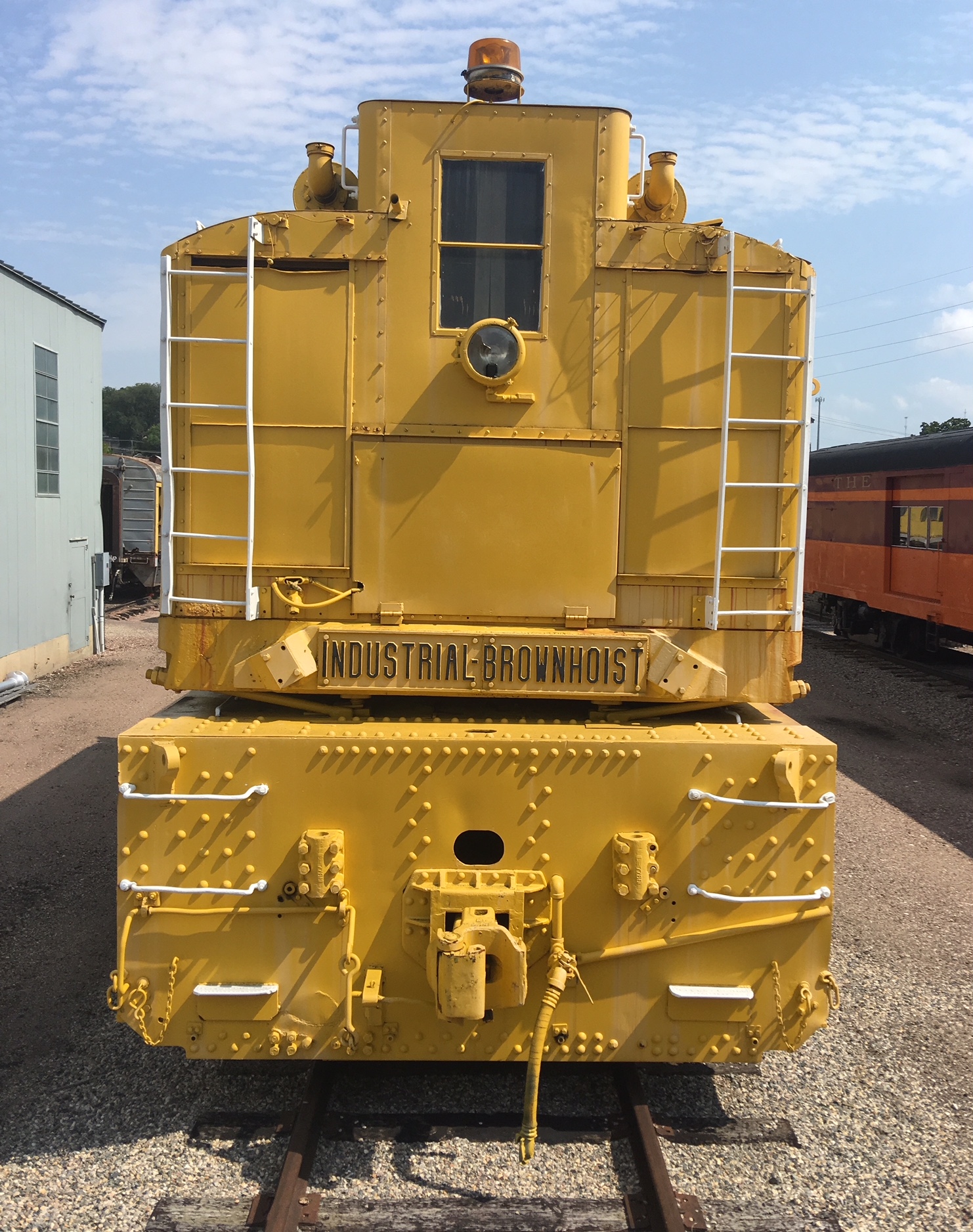
An impressive locomotive shed is home to a working switch engine retired from refinery work along with a very interesting MOW crane. Note: large chest below headlamp on loco is not a toolbox, it is the cabinet housing for the sand cylinders.

The cab of the diesel switcher is impressive as a static piece of industrial equipment, but our guide offered to start it up which further impressed the heck out of me. Nothing better than the sound of a diesel locomotive coming to life. Doubly impressive that our guide effortlessly cold started this large diesel locomotive.

The Milwaukee Road used MOW vehicles as do all railroads here are two interesting examples:

Speeder used to haul men and tools when coupled with a trailer, it was propelled by a simple gas engine seen here in its own shed at the Heritage Center:

Another MOW vehicle was a tractor equipped with rail traction and coupler: soft rubber tires carry the vehicle over the tracks, rail wheels align with rails, operator engages hydraulics to slowly lay the rail wheels in place on the tracks, rail car couples with tractor thus making simple switching functions in the yard possible. The tractor was limited to sideways movement on the rails, it is a unique and interesting piece of railroad history.

Note: sand cylinders and coupler with lower piston to adjust height

360,000 pounds of heavy duty machinery, this rail crane boasts two engines: one for the wench and one for the swiveling deck, it is also one big crane that is capable of lifting a locomotive off its trucks. Pictured on the deck of the behemoth crane car is a thick heavy cast steel yoke used to fasten either side of a locomotive shell for lifting and/or righting a locomotive after derailment. This too is operational although it was not running during our visit.

Two interesting original Milwaukee Road cabooses include the standard bay window design used by numerous North American railroads, but a big difference applies to the two in the Heritage Center collection. On the left can be seen the standard design caboose mounted to a very long deck matching the overall length of coal cars used by The Milwaukee Road.

Bright paint and lettering adorn the exterior of the 01960 caboose while inside the caboose shows its original charm and splendor in you are tough as nails, sport steel toed work boots, overalls with plenty of mends and grease. Otherwise these cabooses were full of hard steel edges and no much in the way of ‘comforts of home,’ but railroad people are durable to machine and weather visiting these rare cabooses gives a window of working life of the end car.

The original turntable is fully operational with a few coaches alongside, a recent newsletter comments on the feasibility of rebuilding the roundhouse, it will be a fascinating addition to this impressive museum.

Membership is reasonably priced at $25/year: http://www.montevideomrhc.org/membership.html

Address: Milwaukee Road Heritage Center-Milwaukee Road Depot, 301 State Road – Suite 1, Montevideo, MN 56265

Lastly: I briefly mentioned the HO scale model railroad earlier in this post, but it too deserves a few words as it encapsulates the history of Milwaukee Road railroading in Montevideo, MN which was an important layover for cattle coming from the Dakotas and heading to Chicago. Several digitally operated F7’s make their way along a very large layout with many scratch built structures and scenery plus custom painted mural surround.

Siding: the locomotive axle bearings were greased with packing within a hinged covered box referred to as a journal box

upgraded Timken bearings can be seen on the 360,000 pound crane which does away with the journal box

 

Excursion: Great Northern and Cascade Railway

A few hours drive from Seattle to Spokane in the Cascade Mountains of Washington state is a small railway for railroad enthusiasts, it circles the station at Skykomish and offers free rides to all who climb aboard: all day long!

The small railroad encompasses a complex design featuring a snow tunnel, masonry tunnel, and bridge. Along the route the train embarks on a well landscaped trip with the Cascade Mountains naturally framing the town of Skykomish, WA.

Sixty volunteers donated their time and energy to lay the extensive track work 5 years ago whose organization owns a couple of locos and ride on cars. A surprisingly fun ride that includes two separate loops around the station and outer perimeter of the property, it even includes a very nice locomotive shed.

Inside the station visitors can enjoy displays of early Great Northern Railway artifacts, its porch serves as a very good viewing platform of the active BNSF mainline.

The most Northerly Transcontinental Railway line in the United States the Great Northern Railways connected St. Paul, MN and Seattle, WA until 1970. The natural landscape in this part of the United States is spectacular with many train sightings possible as BNSF operates long trains of mixed freight and unit trains of lumber, mineral, and petroleum. The drive alone is a recommended spectacle, and railroading history is an added bonus.

Siding: a very rare small crane for moving blocks of ice is part of the collection of the Great Northern and Cascade Railway

Excursion: California State Railroad Museum

A railroad museum of particular interest to railroaders of all ages is this one in Sacramento, CA: California State Railroad Museum: https://www.californiarailroad.museum/

Located in Sacramento the museum is situated in what is called Sacramento’s Old Historic District alongside several blocks of rebuilt historic merchant and railway buildings.

A day long adventure with 2-4 hours in the railroad museum alone. Very friendly museum staff and guides describe the history of early railroading in CA and the West.

The museum’s exhibits are on par with other well regarded museums: large ambitious dioramas and restored trains.

photos (above and below): Built in 1862 (Philadelphia) and in service November 1863 (Sacramento) Central Pacific Railroad No.1.

photo (below): Virginia & Truckee Railroad No. 12 Genoa, Baldwin, Philadelphia 1873

photos (2 above/2 below): North Pacific Coast Railroad No. 12 Sonoma, Baldwin, Philadelphia 1876

photo (below): Virginia & Truckee Railroad No. 13 Empire, Baldwin, Philadelphia 1873

The train collection is rather small in comparison to other railroad museums most notably the Railroad Museum of Pennsylvania, but it is very strong on what it has including the final steam locomotive purchased by Southern Pacific: 4294 cab forward locomotive with tender. I was in awe of this loco for its sheer mass and size, and several groups in the museum at the time were in awe too! It should be noted that not all locomotives are on display at any one time, it is notable that the collection owns 8 of the surviving 45 full size steam locomotives built prior to 1880.

Southern Pacific 4294 cab forward steam locomotive built by Baldwin 1944, it featured oil fired tender with a combined weight of a million pounds.

Displaying fine early and rare steam locomotives is one facet of the displays in the museum which also includes a Santa Fe F7 and a display model modern aerodynamic electric by Siemens.

For toy train collectors there is a display including a few Marklin gauge 1 examples and Lionel Standard Gauge trains, I did not have the time this trip to tour this part of the collection, but I understand it is very good!

Along a wall on the way to the exhibit hall is an early railway regulator built by Seth Thomas in pristine condition and lettered for the Santa Fe railroad, it is perhaps the finest American railway regulator I have ever seen. Keeping trains on time and schedules tracked was helped by precision eight-day regulator clocks such as this fine example that incorporated a mercury pendulum which compensated for changes in ambient temperature.

Sometimes museum displays can go off the rails and detract from the historical importance of that which is exhibited, but in the case of the late 1920’s CN sleeper coach featuring moving train simulation it is WOW! Utilizing dim original lighting fixtures this coach from the ‘heavy weight’ era is fully furnished with original folding seats and bunks found in Pullmans of this era. The periodic flashing strobe light in the darkened windows give that passing scenery affect fully accentuated by the gentle rocking of the entire coach car, one has the going back in time feeling (sorry for cliche).

The AT & SF Super Chief Cochiti dining coach starts with a tour of the large kitchen followed by the dining room set up with tables dressed with china sets from various railroads: a great collection in and of itself. The appointed tour guide played chimes appropriately tuned for breakfast and dinner announcement.

photo (below): near the loco shed sits a brightly painted Union Pacific caboose with operating number 25256

A superb example of a crane is this one located at a siding for loading and unloading trains arriving in Sacramento, CA.

Capping off a fun day at the museum is the museum shop featuring lot’s of very good railroading books. And check ahead for featured excursion trips!

Marklin F7 A-B-A sets: improving performance

If you are lucky enough to own one of the Marklin F7 sets “Alaska” or “UP” consider this easy repair. Or if you don’t like the wires running through the locos consider this easy repair.

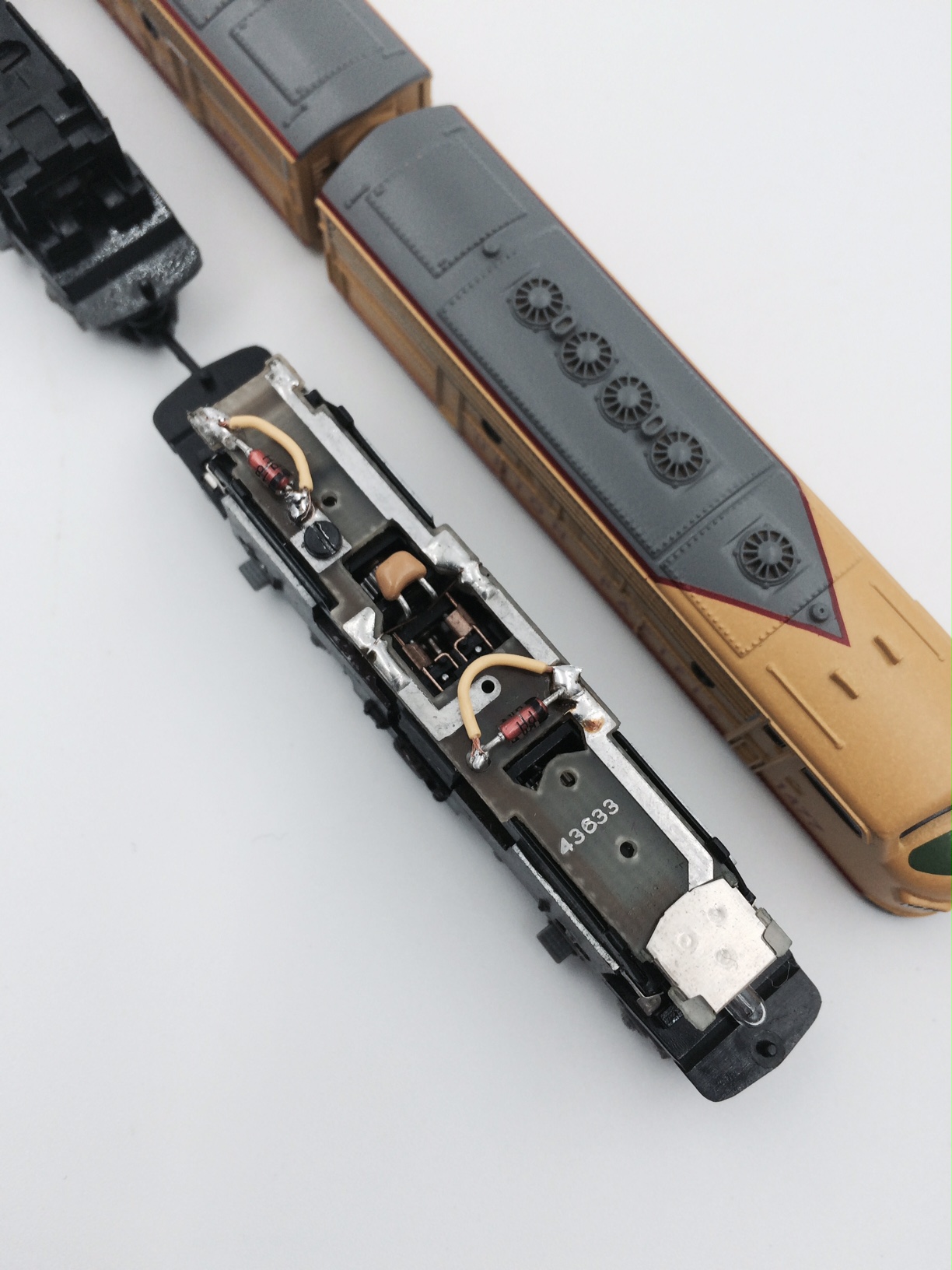
Removing the wires is step 1: cut the wires before removing the shells and carefully remove the wires leading to each circuit board.

Soldering in place four very short wires is step 2: cut 4 small wires to bypass the 4 diodes on both circuit boards and carefully solder the wires in place.

Result: no wires running through the A-B-A units and much improved running performance thus allowing each locomotive to work independently of each other. Note: headlamps will light in both A units at the same time.