Category Archives: Laser Cut Buildings in Z

FS-Italia class ‘F’ boxcars: limited FR release

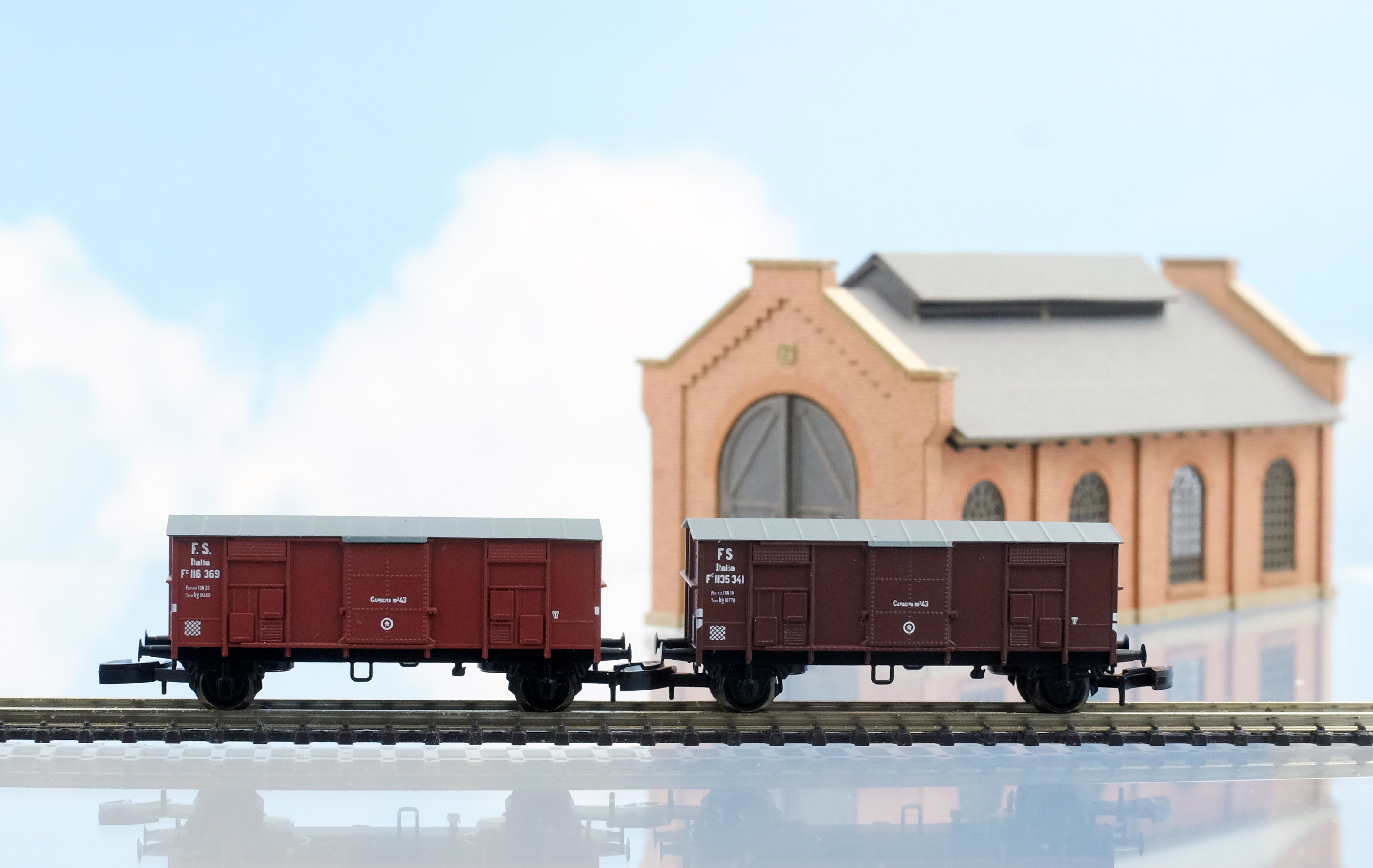
Blink and their gone such is the case with new limited releases by FR. This set of class F boxcars lettered for FS-Italia is limited to 30, it was sold-out and off the website in a couple of days last week.

What distinguishes Italian boxcars of this type are peaked roofs. Two paint schemes are presented in this set including a reddish brown and chocolate brown both with blue/gray roofs. An older Archistories Prussian loco shed (still available) adds character and scale to this minimalist diorama.

A combination of plastic and nickel metal parts assembled on a metal frame characterize the construction of these cars and generally FR rolling stock; few exceptions include all metal construction, but heavy relief detail work is best carried out with injection molded plastic. Cars have great detail and crisp lettering. This is the 3rd release in the past month of FS boxcars, all sold out fast.

Siding: Archistories “Locomotive Shed”: ARC-113111 available from ZScaleHobo.com and ZScaleMonster.com

SBB CFF FFS L2 Freight Car

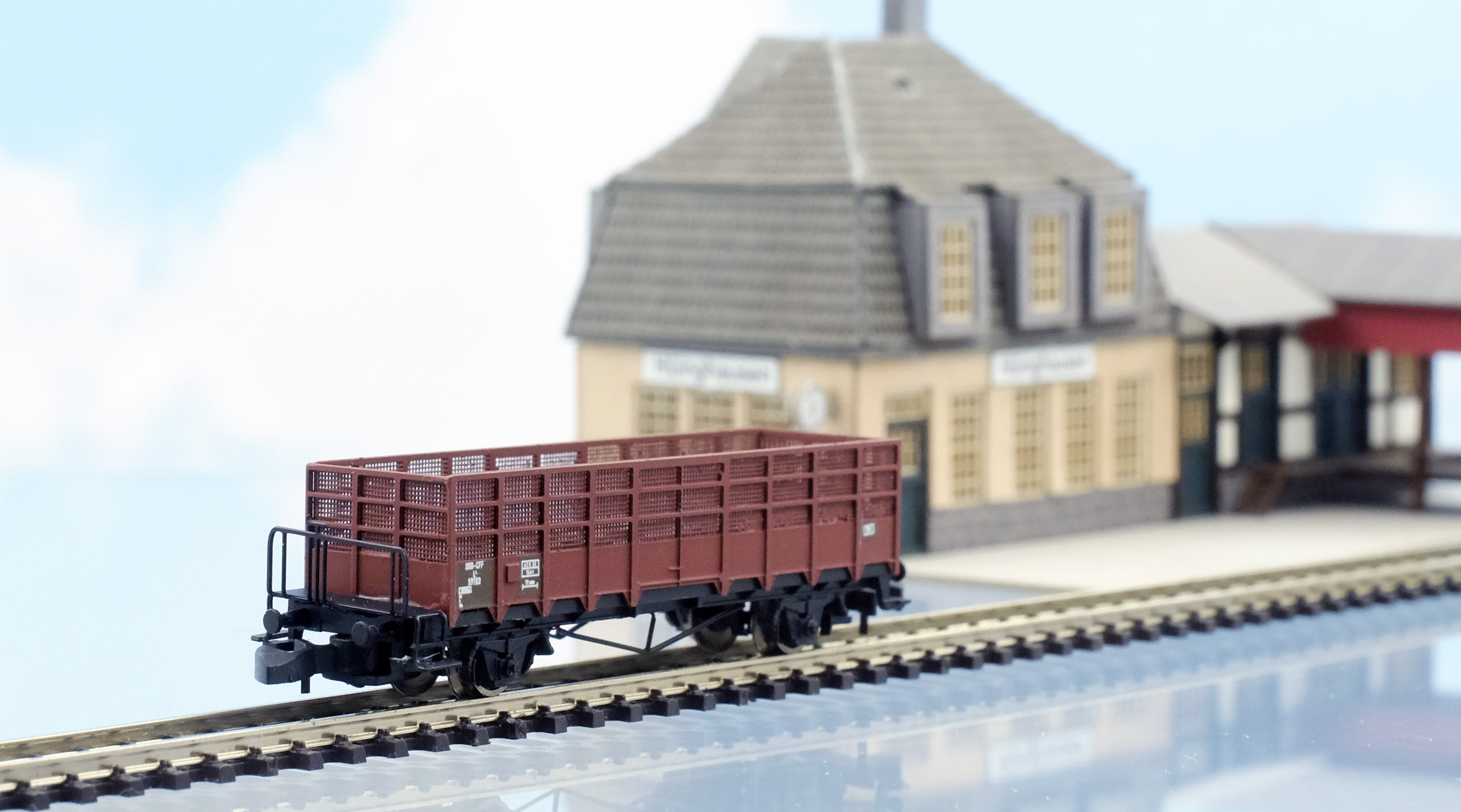
Released as a kit, this type L2 freight car for SBB CFF FFS was produced by FR. It was delivered with nickel silver parts and dry transfer lettering, this one I purchased assembled from an Ebay seller.

The kit is another early example that used some Marklin parts with FR add-on parts as well as design. The chassis and wheel sets are Marklin and all other parts are FR. Nickel silver parts arrived on a sheet that required separation of parts followed by painting and lettering. The modeler who put this one together did a pretty good job, it appears 5 minute epoxy was used as the cement. Note: a final coat of semi-gloss water based lacquer is sprayed over the decals for protection.

The L2 freight car is used on the Swiss Federal Railways to haul scrap metal. The open grate design on top half of car versus solid sides maybe used to cut down on car weight.

Assembling FR kits is for experienced modelers, instructions are always printed in German and knowledge bending and cementing thin metal parts is a further requirement. Best painting is carried out with water based paints and airbrushing.

Siding: Faller’s laser-cut Bahnhof Huinghausen station provides the backdrop for this post.

SJ Ra 994 “Rapid 10”: FR recent release!!!!!!!!!!

Applause applause!!!! FR would win the Z gauge “Best Model” of the year if such awards existed. The recent release and still available 46.132.21 is based on the prototype class Ra 994 “Rapid 10” lettered for SJ.

Just 10 Ra’s were built by ASEA between 1955-1961, they were used on express train service for 30 years. The subtle resemblance to America’s F7’s is not an accident for it was the inspiration for the Ra’s design.

Typical of Scandinavian locomotives is the inclusion of snowplows modeled in metal by FR. The locomotive features brushless motors, it is recommended regular servicing at 50 hour intervals. FR advises their shop for servicing due to the engineering complexities of their locomotives, sounds like the precision workings of a fine German camera or car. On the tracks FR’s locos run smooth and quiet with bright LED lighting.

This is the 2nd Ra locomotive released by FR the 1st was the earlier Ra 846 (#46.132.01), its headlamps included 3 large aft and fore this one is based on a later prototype which included a headlamp modification. FR is aware of all the historical details and changes thus rest assured each model is well researched and accurate in Z.

FR 46.132.01 – limited release of 32 total

FR 46.132.21

Siding: Faller’s “Corner Townhouse” item #282782 card-stock building is the backdrop in this post.

Factory Weathering: Marklin 82267 boxcar

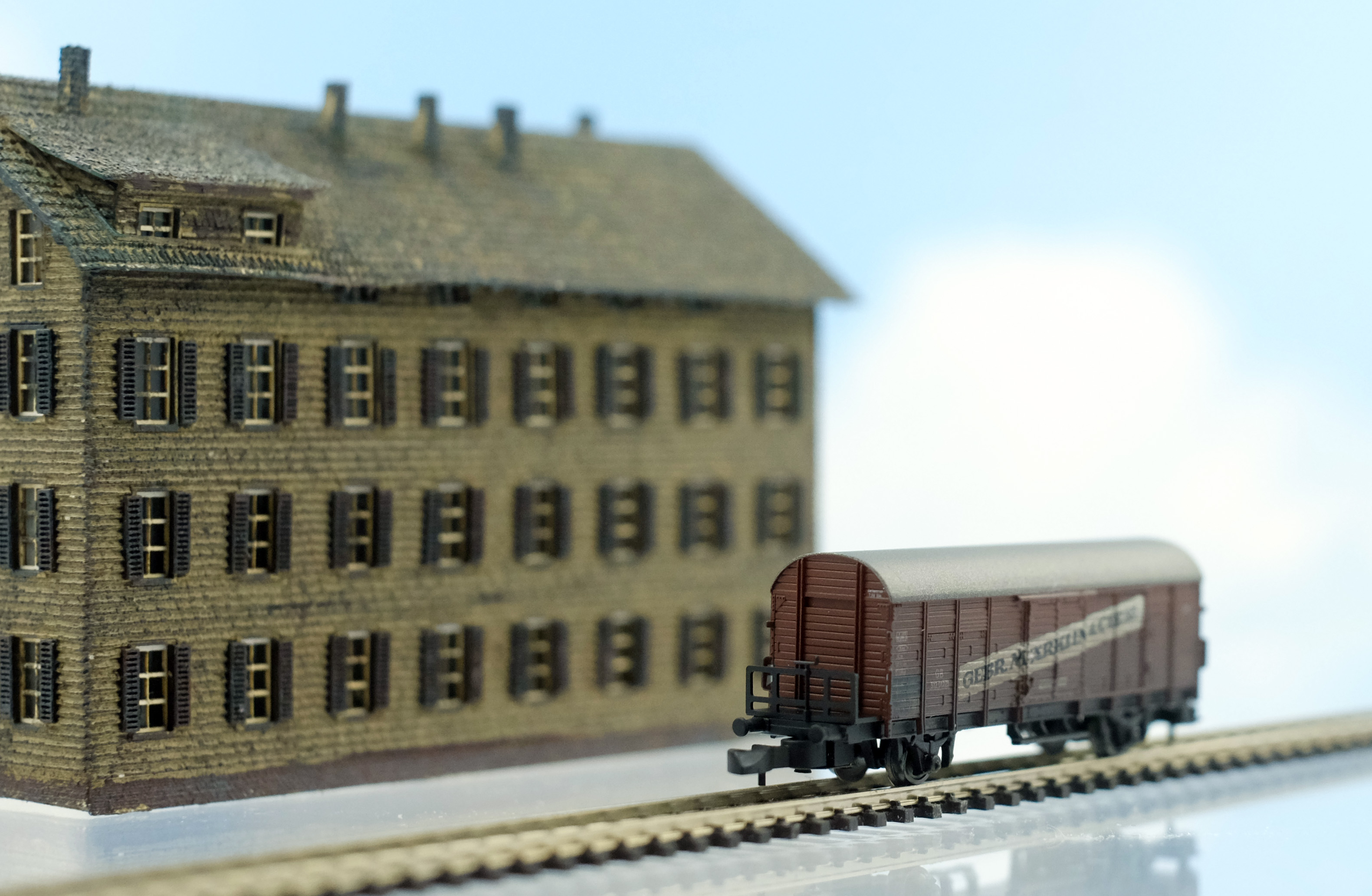
Marklin’s factory weathering doesn’t get any better, and this example is another superb example. Featuring a post on one freight car is worth the effort, single cars can sometimes be overshadowed by the glaring goodness of fancy beautiful train sets and locos in the mini-club program, but individual cars add interest at sidings as they are essential to railroad operations.

Turn this car in the light and depth of detail reveals those qualities such as crisp timber construction, lettering and tiniest bolt heads.

Mated with the early Marklin logo this type GI high capacity boxcar with brakeman’s platform is Era III and weathered to perfection.

Note: The prototype of this Era III boxcar was perhaps loaded with diecast H0 locos and tin-plate rolling stock and other Marklin toys of the 1950’s.

Note: The un-weathered version of the GI boxcar with Era III Marklin lettering was featured as the 2009 Museum Wagen (Item #80020).

Siding: MBZ building kits such as the one featured in this post are available in the United States exclusively from Reynaulds.com. MBZ kits are a bit more primitive and tricky to assemble as compared with Archistories kits which are rigid precise constructions. A natural old weathered look is inescapably linked to MBZ, they are good kits to round out the architecture on a layout or diorama.


Marklin 81699 diesel train set with interesting load

Hardly enough sets seem to have made it to the United States, but for the lucky few the 81699 train set featuring a diesel locomotive and 2 freight cars with loads is another highly desirable version of the V100 locomotive.

Favored by its operators for good handling, visibility, and ease of maintenance, the V100’s side panels were completely removable allowing full access to the motor and components.

Marklin’s “Light Freight Train” 81699 Era III train set is packaged in a small carton with current graphics, it includes the locomotive with operating number V100 2112 and 2 type X 05 freight cars with Tempo Hanseat delivery truck loads. The vans feature metal construction and rubber tires that roll. Locomotive uses the traditional 5 pole motor with brushes, it features LED lighting that change over with direction of travel. Note: prototypical framework holds trucks in place.

A mighty fine design and production makes this and all the V100’s extremely good reliable runners with excellent pulling power. If you need to replace brushes the shell simply pulls off and snaps back in place.

Train can be seen traversing one of the 4 bridges at Hamburg’s Dammtor station released a few years ago as items numbers 89792 (station) + 89793 (arcades and bridges).

Siding: assembling Marklin’s Dammtor station 89792 is fun, it requires many hours to construct, but the completed project is a beautiful. Special note: Dammtor station kit has a 2 layer roof sheathing each piece is only glued to building edges one side at a time and allow to dry. Using glue between the sheets and above the trusses will lead to permanent rippling of the materials.

Marklin 89982: Turntable with accessories

A number of options exist for buying a Marklin Turntable beyond new and used with dealers offering new old dealer stock of the original turntable alongside the current offerings by Marklin. A release from 2014 included the turntable with accessories as item number 89982, this included 2- three stall loco sheds based on the “New Objectivity” architectural movement and a railway administration building.

Marklin has discontinued the 89982, they are now offering the turntable with controller and transformer only as item #89983, the loco shed building kit is also available as an accessory with item #89835. What is currently not available is the build kit for the railway administration building which is a wonderful example of the Bauhaus architectural style of the early 20th century and is fully complemented by the same era roundhouse. The railway administration building was reason enough for me to buy 89982 which is as beautiful in person as the Marklin promotional photos.

The Railway Administration Building features 2 partition walls, numerous windows and flat roof, its measurements: 7 1/2 inches (length) x 1 3/4 inches (depth) x 1 11/16 inches (height).

Building the kit is easy and straightforward with no issues.

Six stall roundhouse features steel framework and brick infill, it is a very attractive building with rather plain doors that do not swing open and closed with the precision of the Archistories Roundhouse ARC-112121 and accessory Stalls ARC-113121. Interior supports are a bit flimsy and easily bend out of shape, but overall a very good kit that I recommend.

The kit can be built as two separate buildings with 3 stalls each or as one 6 stall roundhouse in which case two exterior walls are omitted, I opted for two buildings.

Unlike the Archistories loco sheds which incorporate 2 part window and door framing with snap in place glazing this kit requires gluing glazing to the interior side of the door. To compensate for the plain doors I decided to age them. First I used a light wash of grimy black (water-based) paint on the interior side of the glazing followed by dry brushing grimy black to doors and brick work around doors, I further lightly aged the bricks along the ground level around the perimeter of the buildings. Light and heavier pressure was used to vary the amount of color to the doors and bricks using dry brush with very diluted paint. Doors readily absorb paint so test a small area first.

Siding: original 3 pole motor turntables can be upgraded to 5 pole with part number 211914.

Archistories: New Possibilities for the Marklin Transfer Table

Archistories has designed and engineered a new loco shed (ARC-104171) for the Marklin Transfer Table 89941 currently discontinued by Marklin. The new 5 stall shed is based on steel framework with brick infill. Other examples of German “New Objectivity” architecture can be found in Archistories offerings including the very excellent single loco shed: ARC-101101.

Marklin’s original two stall loco shed for the transfer table was a rather chunky plastic example that featured remote activated doors that “snapped” open. The just released shed by Archistories is a much finer example of prototypical architectural rendering with large windows and skylights.

The doors on this building are comprised of two parts with glazing that snaps into place versus glued on window glazing seen in other manufacturers’ models. Owing to greater build quality than can be found in other manufacturers card-stock buildings are doors that swing open and closed with great precision.

Overall the building goes together quite systematically with relative ease, the only difficult step is assembling the skylights, here there are delicate framework parts that have to be bent, but I have a solution. Using the blunt side of a pair of tweezers burnish the un-scored side of the card-stock framework,

the parts will slightly curl thereby allowing a much easier bending of these parts. Also when installing the window glazing use your finger nails or toothpick to gently push glazing in place versus a sharp object that could scratch or dimple the plastic.

Available in the United States at ZScaleHobo.com and AScaleMonster.com.

Good Luck and have fun railroading!

Archistories: Cooling Towers with active steam simulation!!!!

Adding another essential release to Z is Archistories “Cooling Tower”: ARC-701171 (1 tower per kit). Here is an interesting example of industrial architecture whose scale will be very interesting on a layout.

These cooling towers use a lot of filigree parts to form the framework of the model along with railings and steps. Overall the kit is pretty easy to assemble, it is well designed and the parts are precisely cut. The only difficulty with this kit is working with the ladder, steps and railings due to their lightweight nature, but careful handing and a no rush pace is helpful. Very small drops of glue are all that is ever needed with these precision card-stock kits, use as little glue as possible!

A few of Archistories kits include motor driven parts such as windmill and water wheel, this kit offers something different, it has a smoke generation device which will simulate the steam coming out of a prototypical cooling tower.

The device comes complete with the liquid required to stir things up in the smoke chimney whose leads are hooked-up to the accessory leads on the mini-club transformer or better yet a Marklin distribution strip and controller. The manufacturer provides an acetate disk to protect the base of the cooling tower from spills. And the building is also designed to be lifted off of the foundation for refilling the smoke generator thus gluing the tower to the base is not advisable if you plan on using the smoke generator.

At 4 1/2 inches tall the scale of this building looms over the rather large diesel locomotive passing by. Adding this new architecture to your layout will be an interesting focal point for trains passing through the industrial landscape as it will be a good reference point for prototypical modeling.

Available in the United States from ZScaleHobo.com and ZScaleMonster.com.

Railex versus Z-Modellbau: Kof II showdown

Until Z-Modellbau took the challenge to manufacturer a Z Kof II with a Motor (!!!!) our choice was limited to mechanical rolling non-motorized Kof’s by Schmidt and Railex.

The Railex example here is cast brass (red paint scheme lettered for DB with open cab and black running boards) with fine detailing inside the cab, it was a very good example of a Kof II that Railex produced along with variations of this type.

Headlamps are non-working in both locomotives but Z-Modellbau rendered them white in perfect circles versus Railex which are hand-painted silver.

What to do with a non-working model train: use it of course! Before brushless motors manufacturers of Z gauge had certain limitations placed on their ambitions. Z gauge is already small in size so therefore modeling the smallest prototypes yield problem after problem including where to put a motor and gears. The solution with their larger steam locos and tenders was locating the drive mechanism within a passenger or freight car hence they were called “ghost cars” because they became hidden locomotives, but they allowed the locomotive to pull cars so to speak figuratively not literally. I collect Railex, they are beautiful and fun to behold. As for ghost cars I have never owned one, I understand they can be temperamental and many I see for sale are offered “not working”. Ghost cars can be built by industrious engineers with a clever creative side which describes most of us Z-scalers, if you choose the to take the challenge the rewards are big and stalled trains from 19th century Germany may come to life on your railway line.

Photo: no couplers on Railex, Z-Modellbau uses Marklin compatible couplers of their own design that unobtrusive in this small loco

Now the time is ripe for ambitious manufacturers to create smaller locos in Z that function, today brushless motors from Switzerland are available in a variety of small sizes so releasing new locos with this motor should be easy? Wrong. From idea to final market ready model is a design and manufacturing “Matterhorn” so to speak. Having the idea is the first step followed by researching the prototype’s blueprints, putting into scale, designing the parts and assembly. Every step is time consuming and difficult with a fair share of creative thinking, ingenuous problem solving and sheer expertise in tooling and production. The latter always flabbergasts me, how can anyone be gifted with such abilities that tiny tiny tiny details appear in such small locos at the same time concealing their build.

With the Railex Kof which is cast with add-on parts in cast brass the model is beautiful with a securing plate screwed to the undercarriage that simply holds the wheel-sets on: simple and beautifully designed. This example does not have couplers thus making it a stand alone model train.

Photo: Railex Koff hauling livestock boxcar both lettered for DB

The Z-Modellbau Kof II for NSB has an enclosed cab with glazed windows and their own unique design for a Marklin compatible coupler. A 10 volt coreless motor runs the show including gearing that allow smooth acceleration and deceleration but without working headlamps. Headlamps are beautifully modeled as if lit. Locomotive is weighted and balanced due to its metal nature throughout so pulling power is very good.

Photo: Railex Kof II is true to prototypical scale giving the boxcars the impression of great size

Small locomotives serve very important functions including shunting and branchline while others not covered here serve MOW (Maintenance of Way) service, they (speeders) are still smaller than the kofs  with one purpose: track inspection.

Siding: seen here are the two livestock boxcars comprising the Marklin 2 car freight set: 86602. For the first time this car type features interior detailing in the form of gates, it also includes laser cut build kit for loading ramp and movable fence sections.

Z-Modellbau builds the legendary ML 2/2 in Z!!!!!!!!!!!!!!!!!!

Maffei built the ML 2/2 steam locomotive in 1906-1908, Z-Modellbau built it first as a Z scale model. The observation has been made many times equating the appearance of early German steam locos with toy trains, but the ML 2/2 was a hardy locomotive that proved it’s worth.


Built for the Bavarian State Railways the ML 2/2 was equal measure to the PtL 2/2 built by Krauss. Service duties included all such description on branchlines, and it could be operated by a single driver due to its semi-automatic gravity fed firebox. 24 locos were produced until it was retired in 1924.

Z-Modellbau has done it again with one of the finest Z scale locos ever available, the fine detailing of this loco has no rivals. And it is very small and true to scale with the prototype’s external cylinders modeled with smooth moving side rods of an ingenious design. This little gem is all metal construction featuring brushless motor and window glazing in the cab.

The ML 2/2’s place in history has been preserved in Z by Z-Modellbau, every inch of this is a masterpiece even though it’s total length is less than inch.

Running performance is superb at slow idle through full throttle.

Marklin’s 82391 (2005) high capacity coal hopper lettered for K.Bay.Sts.B is a perfect choice for this loco as well as Marklin small loco repair shed 89805.

Photo: here the ML 2/2 details are seen with coal bin in cabin roof and Marklin compatible coupler.

The scaling of Z-Modellbau locos creates a dramatic appeal on the layout due to their small size. Juxtaposed next to larger more powerful stream loco the ML 2/2 will stand out next to those towering express locos. Train sheds and buildings will also offer interesting juxtapositions and already there are buildings by Archistories and Marklin that fill in this time-frame for authentic prototypical railway scenes.

Photo: on a siding or near a loco shed the idling ML 2/2 will have great appeal on rural railway lines hauling passenger and/or freight.