Category Archives: Marklin Z Insider

Repair Notes: mallet locos 88290-88294

A very interesting Marklin Z loco of the ‘mallet’ type was introduced in 2004 as Insider Model 88290.

The class 96 loco has been released in 5 versions to this point in time, but Marklin did not limit the release of a ‘mallet’ type loco to this class, they also introduced the class 53 in 2007 as Insider Model 88053.

What characterizes a mallet locomotive is first an articulated frame along with two independent wheel sets. Invented by the Swiss engineer Anatole Mallet this type of locomotive was highly successful in mountain railways, and in the United States this loco type was used in coal trains. The articulated frame allowed for negotiating sharp turns while high and low pressure steam powered two sets of driving wheels. The front set of driving wheels form the ‘Bissell’ truck which received low pressure steam through a receiver after high pressure steam powered the second set of driving wheels first. Variations between European and American ‘mallet’ locos follow the basic design principle, but each varies by other factors including length and power. Marklin’s two mallet designs represent very large and powerful locos one of which never existed beyond blueprints as is the case with versions of the class 53: 88053, 88054, and 88055 (pictured).

To repair the mallet locos of class 96 some patience and practical experience in the repair of mini-club steam locos is required. Marklin Z steam locos have one set of driving wheels, the mallets have two sets and therefore one must treat each as independent by repairing one at a time. These are complicated locos, but they are so well designed that taking one apart and reassembling is relatively easy for those with some experience repairing locos with side rods. Note: wheels must be correctly orientated to allow free movement of side rods, side rods bow out when wheel sets are improperly installed in all locos with side rods.

This post came about rather by accident, I recently purchased an 88291 thereby completing my collection of this type loco, but it arrived with hardened oil syndrome which can be expected with dealer old stock. Tell tale signs of hardened oil syndrome are lights that work without a hum of motor or movement of wheels. The oil Marklin uses will harden over time which is compounded by improper storage. Hardened oil gums up the gears not allowing them to move, it looks like a crust, but it can also be sticky to the touch.

Note: white gunk near center of photo

To remove hardened oil a mild solvent is required, toothpicks work to loosen up crustiness and soaking NON PAINTED surfaces in “Original Windex” (blue). Improperly storing locos includes side down, they should always be stored wheels down. The one I just received was one such example of a loco stored long term on its side: hardened oil pooled on one side throughout gears and truck housings.

One can see the appearance of hardened oil as white crust, it can otherwise be fluid or congealed as a sticky substance all in the same loco: weird!

One gear is sometimes the culprit at least with this example. Part #226 646 is an interesting gear that sits mounted on a post cast into each truck frame of this loco, thus two are included in this design.

Note: gear can be seen mounted inside truck frame in two photos with yellow background

I have come across this gear on more than one occasion, Marklin’s class E 94 and 194 locos including all versions have this same gear in their design so repairing this loco is a good primer for repairing those. Time and time again it has been proven to me that if the German “krocodil” isn’t moving this gear is completely stuck due to hardened oil. Very careful attention needs to be applied to wriggle off this gear from its post, I use a toothpick over a dish to catch the part.

The transmission in this loco is very long with two worm gears, it comprises two extensions attached to the the tip of the motor (226 631).

So many parts that are required to move in the smallest space comprise a flawless design that includes a sensible tear-down and reassembly design.

Reassembly includes close adherents to correct order of things: no matter loco type small connecting gears always go in truck frame first followed by driving wheels.

Photo shows one truck’s correct assembly without oil pan attached. Note the two connecting gears which are standard with all locos in Marklin ‘Z’, and because they are small it is a good part to have spares of (part #226 645). Coupler and spring are not illustrated in photo, but they would be located on the right side. Side rods slide into black housing and only work one way: side rods of the third pair of wheels are orientated correctly in photo to allow correct distances in the truck mount for all gears. After coupler and spring are placed into their mount the oil pan slides over coupler end, and it is attached by a single screw.

It is always a good idea to keep an inventory of spare parts even though you may never need them because we are talking about the brilliant engineering and manufacturing by Marklin. That being said the motor for this series of locos is part #226 631, it is soldered directly to the pick-ups and solidly held in place to operate the very long transmission.

After each truck is cleaned, oiled and reassembled test it to make sure all gears move freely with the retaining pin and nylon gear installed too! Note: the nylon gear comprises two sets of teeth, one set engages with the worm gears on the transmission and the second is small running on one side of the nylon gear and engages with the post mounted gear previously mentioned. Recommendation: the nylon gear is another part to keep spares of, it is part #223 493.

Last note: if you know the loco is new and never run. And you have the loco taken apart, this maybe a good time to break in the motor and brushes independent of the motor’s engagement with the gears. Break-in: slow speed followed by medium speed, followed by high speed, and then reverse order. About 5 minutes of varying speeds will do.

Good luck and have fun!

Siding: required tools for repairing Marklin Z locos: pliers with micro tips, magnifying goggles, set of jewelers screwdrivers, foam work cradle, dish for holding parts, and guitar picks can be used to help remove plastic shells or shells without retaining screws.

KPEV BR G 8.1: Marklin 88981

88981_1

Marklin 88981 steam locomotive is based on the prototype BR G 8.1 lettered for the Royal Prussian State Railroad (KPEV) with operating number 5239. This was the Marklin Z “Insider Model for 1998.” Based on the prototype, this steam engine carries the photo gray paint scheme as the 7500th locomotive built by Hanomag. Model included the 3 pole motor at the time of release and working headlamps.

88981_4 88981_5 88981_3 88981_2

Marklin BR 216 locomotive diesel class

Marklin produced 4 BR 216’s in Z, this post includes two newer versions: one an ‘Insider’ Model and the other an ‘MHI-One Time Series Release’ from 2013.  The class 216 follows the reclassification of locos in Germany in 1968 thus the 216 is the former class V 160. Modifications to class V 160’s included bumped out ends thus making for an arguably more attractive loco along with internal improvements that included changing from steam heat to electrically generated heat for coaches, it followed that certain exterior changes were also made including roof equipment and sides; the elliptical window which was characteristic of the BR V 160 disappeared, I would deduce that it was appealing but impractical. But some BR V 160’s simply had a name change and others found their way to private industry.

_DSF9702

  1. 88783- BR 216, Era IV, operating number 216 199-0, Insider Model 2011, One Time Series
  2. 88784- BR 216, Era IV, operating number 216 188-3, MHI Release 2013, One Time Series

_DSF9733

Two locos that are easy on the eyes!

Marklin Insider Club Membership

Just received my Marklin Insider membership renewal. Prices keep going up all the time, but not Marklin Insider membership which has gone down $10 bucks, it is now $99 a year and includes the club car, insider loco reservation form, and Marklin Magazin and Insider News Magazine subscriptions. You also get the annual catalog. But you also get the DVD’s “Year with Marklin 1 and 2.” I look forward to the DVD’s with much anticipation, the episodes include much background on German rail through presentations of museums, hobbyist layouts , and more. But the ‘Bonus’ track includes cab rides with the latest including a 3 hour cab ride in Switzerland’s “Glacier Express.”

Collecting Marklin Z and Preserving Train History: 88300, 88301, 88302

_DSF9185

from top – side 1:

Marklin 88300: V300 Diesel Hydraulic Loco, Insider Model 2009

Marklin 88301: ML 2200 C’C’ experimental loco, builder: Krauss-Maffei, 1957 paint scheme

Marklin 88302: ML 3000 C’C’ factory paint scheme after 1957-1958 rebuild

side 2:

_DSF9186

Collecting Marklin Z is bigger than acquiring model trains, it is a collaboration with Marklin: preserving the history of trains. Every collector of trains in all scales is participating in train history simply by collecting model trains, books and ephemera. Our passion for trains is passed on to the next generation, thus block by block trains are well documented and understood thanks to model train manufacturers and their collectors.

Historical preservation is at the heart of some Marklin Z releases including the experimental locomotives: ML 2200 and ML 3000.

The German locomotive maker Krauss-Maffei produced a variant of the 4 axle V200 locomotive in the 1950’s for the Yugoslav Railroad with lower axle loads and improved air conditioning thus the 6 axle ML 2200 was born. Delivery of three ML 2200 locomotives 1.77 meters longer than the V200 took place in Belgrade May 27, 1957. Marklin’s One Time Series 88301 is a model of the ML 2200 prototype.


The ML 3000 represents a rebuilt ML 2200 with increased power and improved transmission. The failure of negotiations to secure an order for ML 3000’s with the DB ended any potential success this locomotive would have for load restricted routes in Germany, the surviving prototype was used in Bavaria before it was leased in 1963 and later purchased by the DB. Marklin #88302 is modeled on the ML 3000 prototype.

In 1963 the DB leased the ML 3000, it was reclassified V300. The locomotive was repainted with the DB color scheme otherwise unchanged. In 1964 the DB purchased the V300, it was used in express and freight service. The service life of the V300 lasted roughly 17 years before it was scrapped. Marklin model #88300 represents the V300, it was a limited production release for Insider members.

As a point of comparison there were 4 total locomotives produced of the ML 2200/ ML 3000/ V300 variants and 86 total locomotives produced of the V200. Maybe the V300 would have been more successful than the V200 if negotiations with the DB had not failed to secure an order for them.


Blue? Prussian Blue rolling on the rails

Marklin Magazin has been published by Marklin for a number of years, it is a glossy well produced magazine with contents covering Marklin trains and train history. And it is included with your ‘Insider’ membership! So what’s with the title of this post Prussian Blue? Prussian Blue is the traditional blue used in blueprints and since 2001 the characteristic color used for Marklin Magazin’s special edition cars. Marklin Magazin’s “Car of the Year” is often Marklin’s car with new tooling for that year, pigmented in Prussian Blue and lettered for Marklin Magazin. Sometimes a theme is introduced such as the 2002 release 80812: type Lgjs 598 flat car loaded with tanks corresponding to printer’s ink used in the production of the magazine. Or the 2006 release 80816: type low side car with brakeman’s platform loaded with real rolls of paper, Marklin notes 20 metric tons of paper are used for each issue of Marklin Magazin. New releases of Magazin special edition cars are available from your dealer through Walthers, but they sell out quickly.

Notes on special Marklin editions

Marklin has and continues to produce limited editions in z scale that include several subcategories: 1. One Time Series, 2. MHI, 3. Export Models, 4. Marklin Magazine, 5. Insider Models, 6. SMI’s, 7. Industry Prints, 8. White Box Editions, and 9. Museum Editions.

  1. All limited edition models should be considered “one time series”, but they vary from official “One Time Series” within the regular production items. Briefly One Time Series are regular production items with  symbol printed on the box next to the item number. These items are produced for one year on a limited basis. In the United States they are distributed through Walthers.
  2. In 1990 Marklin created the MHI (Marklin Handler Initiative) Program. Items falling into this category also include the “One Time Series” symbol: . Under this category models are not only limited by being one time series, they are only available from dealers that are members of the Marklin MHI Exclusive dealer program. The coal transport trainset 81379 + 82379 are recent examples.
  3. Export Models as the name suggests are models designed for railroads outside Germany and exported to those countries on a limited basis. These models can be exceeding difficult to collect, their prices reflect their scarcity. Marklin 82376 is a good example of a 2 car hopper set lettered for the Netherlands. FullSizeRender-3
  4. Marklin Magazine is delivered through membership in Marklin’s Insider Club, models celebrating the magazine feature a characteristic dark blue color and imprinted with the Marklin Magazine logo. Car types in recent years depict cars with new tooling thereby announcing the release of new car types within the regular production line for z. Not every dealer will order these for their inventory and because they sell out fast they can prove difficult to collect unless you are willing to pay a fairly high collectible price after they sell out at the factory.
  5. Insider Models are of two types: rolling stock and locomotives. As a member of the Marklin Insider Club members are given one free car usually of a type with new tooling, they are also given a certificate in their name for securing the locomotive for that year. Therefore the limitation is based on Insider membership and the number of reserved loco’s.
  6. SMI’s are a particular favorite of mine, they are designated as Special Marklin Imprints commissioned privately for printing by Marklin. Marklin collaborates in the process with design requirements, usually a minimum order is 100. Car types for imprinting are 8600’s, 8612’s, 8615’s, 8626’s, 8656’s, and 8661’s. I don’t believe 8626 and 8656 are available anymore for special imprinting. Special Imprint cars include the ‘m’ designating they were printed by Marklin, this is an important mark otherwise they fall into my last category “Industry Prints”. SMI’s are a big category of collecting, these uncommon cars are imprinted with all sorts of interesting graphics variously designating wide ranging content, some collectors only collect SMI’s which speaks to the highly rewarding hunt for these rare finds.
  7. Industry Prints are similar to SMI’s with one important difference, they were not printed by Marklin, Marklin’s contribution is limited to the    unmarked cars only. Privately printed by Baur-Druck Bad Waldsee “Industry Prints” were sold by Schmidt in Germany for distribution in Europe and the United States. Here in the USA some were sold by Modellbahn Freund, St. Louis, MO, their sticker is sometimes attached to the plastic box if you happen to find one of these. This category of special imprints is not covered in the Koll’s books, the only reference is what can be found on the internet.
  8. White Box Editions are special cars typically commemorating special events and housed within a white box.
  9. Museum Editions had their start in 1987, each year a new museum car is released that highlights a company with historic or other ties to Goppingen, Germany home of Marklin. These highly collectible cars are often delivered inside a specially printed tin box and sometimes they include a cast metal truck or car. Most dealers have these in their inventory as they are distributed by Walthers. The rarest of this category are two cars: 1987 (1st year of the museum editions) and #80021 from 2010.


Marklin limited editions are not limited to these 9 categories as this blog will hope to clarify in future posts. The Nuremberg Toy Fair locomotives, one-off’s and limited starter sets further complete this topic, more for future discussion.

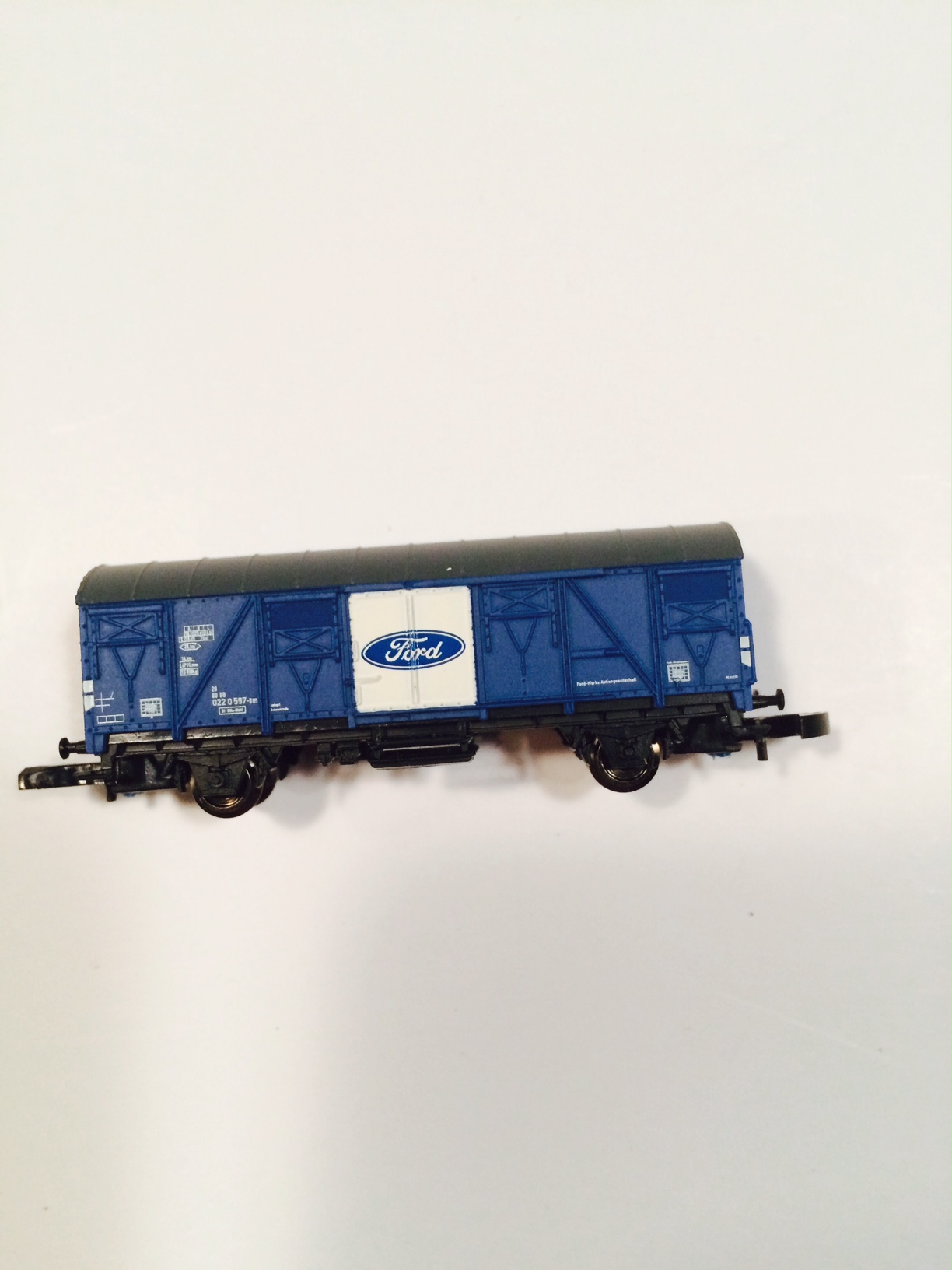
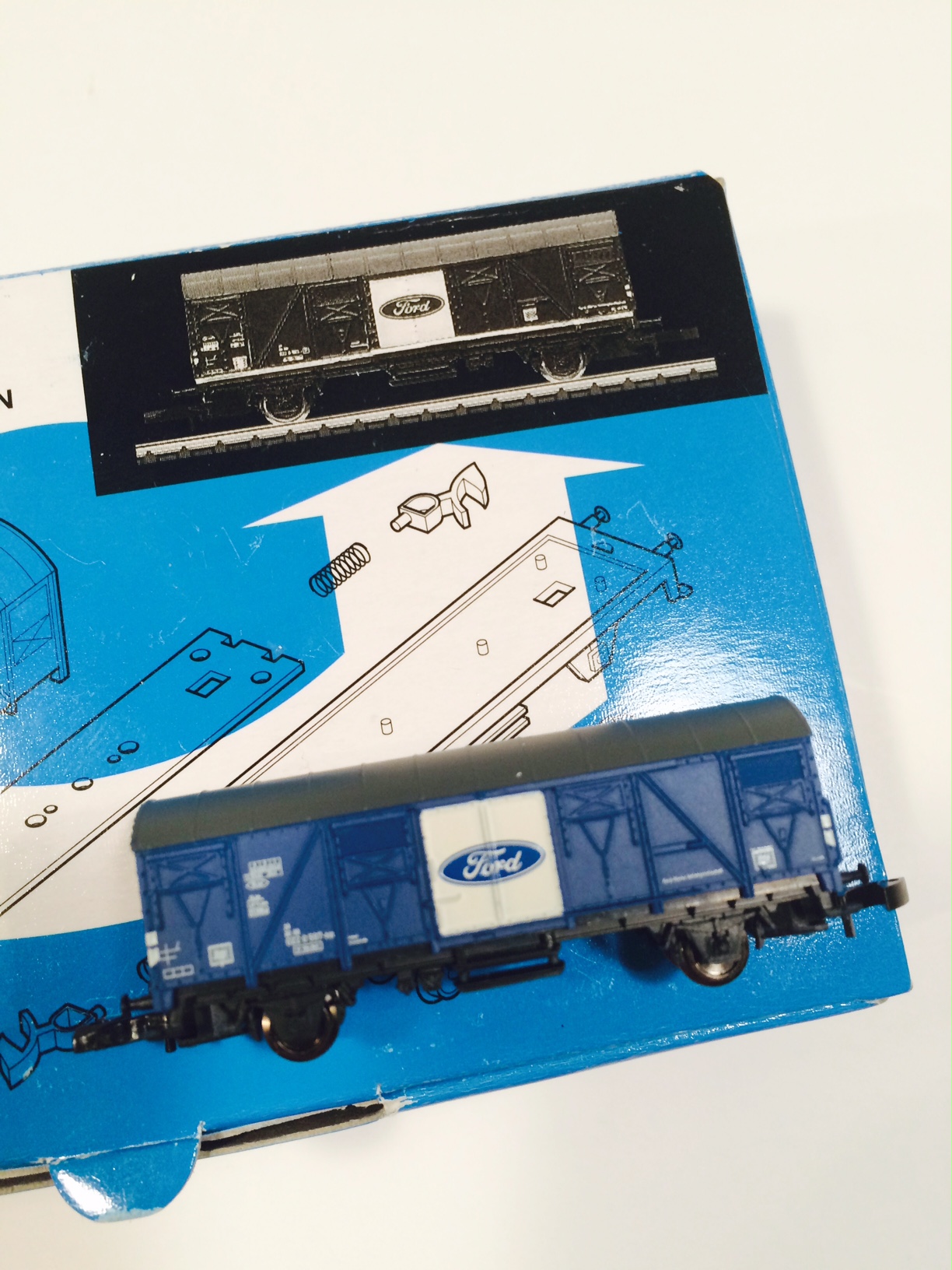
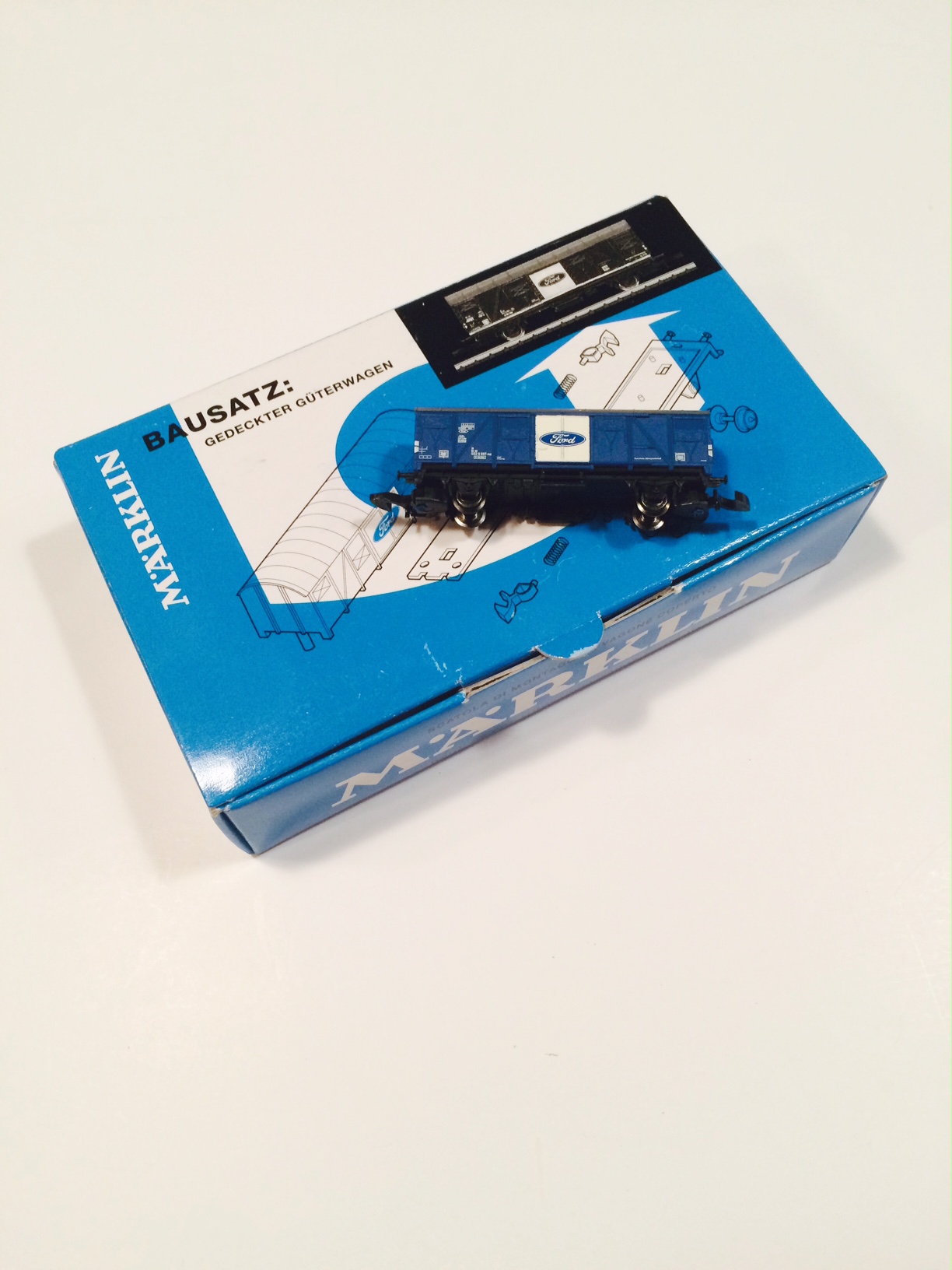
Insider Model 2009 “Ford build kit”

In 2009 Marklin’s Insider car featured a box car lettered for Ford Works, Inc. and used on the German Federal Railroad (DB). Released in honor of Marklin’s HO 4937 build kit from 1970-1977. Inside the facsimile box for 4937 are the component parts to assemble a z gauge box car lettered for “Ford” . Car is relatively easy to assemble taking no more than 10 minutes, coupler and springs being the trickier assembly with the car body. A soldering iron is used to melt the posts during final installation of car body and chassis, great car should be taken when using the soldering iron with these small parts. Exquisite printing!

FullSizeRender-25FullSizeRender-27 FullSizeRender-24

Insider Model 20th Anniversary 82339

Insider Anniversary Model 82339 was offered to Insider members with 20 years membership in the club. Following the same format as Marklin “White Box” special editions this one is a finally printed gloss black box. Inside you will are presented with a power shovel in cast metal and orange paint, 4 Preiser track maintenance workers, and low side car with load of ballast. Track Maintenance Set for the DB is a very limited release.

FullSizeRender-21FullSizeRender-22FullSizeRender-20FullSizeRender-19

Joining Marklin Insider Club

Joining the Marklin Insider Club comes with member benefits in the form of exclusive offers, Marklin Insider News and Marklin Magazine. Plus the annual Marklin Insider car in z gauge. It is easy to join and worth the price of $109.00 annually. One extra cool thing with membership is the annual “Year in Marklin” video. The excitement for being part of this worldwide community of collectors is renewed with each bi-monthly mailing of Marklin Magazine. Marklin Insider cars are each collectible in their own right and often predate the release of a newly tooled cars in the line-up.

Here is the link to join:

https://www.marklin.com/club/marklin.html