Category Archives: Marklin Z

Marklin’s Steam Railcar “Kittel”: 88145

Wow!

I have been waiting patiently and other times impatiently for Marklin 88145, there were times I didn’t even think I would receive one, but last week I took delivery of one from the dealer Frank Daniels (zscalehobo.com). I can only wonder if the release was smaller than Marklin planned with some pre-orders not filled including a second one I ordered as soon as it was announced many moons ago. Note: pre-orders maybe filled, I haven’t received word as of yet that more are not on the way.

88145 is a further milestone in Marklin Z with prototypical accuracy, excellent running performance due to a brushless motor, and extremely fine detail work including many add-on parts. Add-on parts are always part of the finish detail work on Z locos, but the 88145 includes added details only found with the small firms of FR and Modellbau Z whose quality handmade products are unmatched but equaled with Marklin 88145. The add-on parts include cabin chimneys on roof along with top cap for boiler, but also grab-on rails fore and aft (nod to my recently deceased Father-In-Law who was a sailor) with platforms and accurate detailing on one end with buffer beam detailing including hoses, step-ups and coupling.

The paint scheme is crimson with lettering for DB thus an Era III locomotive but built in 1905 with firebox designed by Eugen Kittel. Two class Kittel CidT 8 steam powered rail cars were used on provincial railroads in Germany until their retirement in the early ’50s. A rather remarkable little rail car with but 4 passenger bays this locomotive would have hauled a freight car or two thus offering a dual purpose on less profitable routes.

As for the model — 88145 will prove to be a very big deal in Z modeling! And under the hood just as complex in design and fabrication as the outer shell! Parts diagram includes numerous mechanical and add-on parts thus confirming the necessary amount of assembly labor involved in this release.

The only point of comparison to be made with small high end manufacturers is add-on parts are made of injection molded plastic rather than etched nickel silver, but it is hardly a discrepancy worth noting as these parts are perfection! Running performance although not tested on all track by this reviewer could be assumed to be rather poor through turnouts or dead spots (due to lightweight and short wheelbase), but continuous rail there is no loss in power or performance witnessed.

All positive! The new Marklin 88145 is superb, but it maybe a once only production: the price tag on this release should have been comparable to other locos on the market with similar workings and detail work, instead it sold for at least half maybe 3 times less than comparable locos on the market: assembly labor alone must have been very high.

I would like to see Marklin continue with outrageous models such as this one, maybe a second line like the “Fine Art” series from a few years back that did not take hold.

A quick note on the carton: loco was delivered in the current white carton with loco housed in a two part plastic sleeve similar to ones used in the HO line to protect the delicate add-on parts, mine arrived with pristine paint and nothing broken. *Even the box was thoughtfully designed! Lastly: box has a “Made in China” sticker attached to it which makes perfect sense to me, Chinese labor is very good with fussy and intricate assembly of tiny parts and this model is exceptional in every way, it maybe the best Z loco in terms of detail work and craftsmanship.

Siding: I am a long time collector of Marklin Z, all periods in Marklin Z are represented in my collection. A few fears ago Marklin produced Z in China much to the consternation of fellow collectors, with very few exceptions “Made in China” did not resonate with me as poor quality or less collectible than “Made in Germany”, Z products continued to arrive during this time-frame that more than satisfied this collector. And I suffer from extreme pickiness! First time I have admitted to that in public. We may only have the Marklin 88145 because it was made in China which may turn out to be one of the most sought after models by Z-scalers in years to come.

A perfect boxcar for the loco and timeframe is a G 10 from set 86391 or 86392 (not pictured).

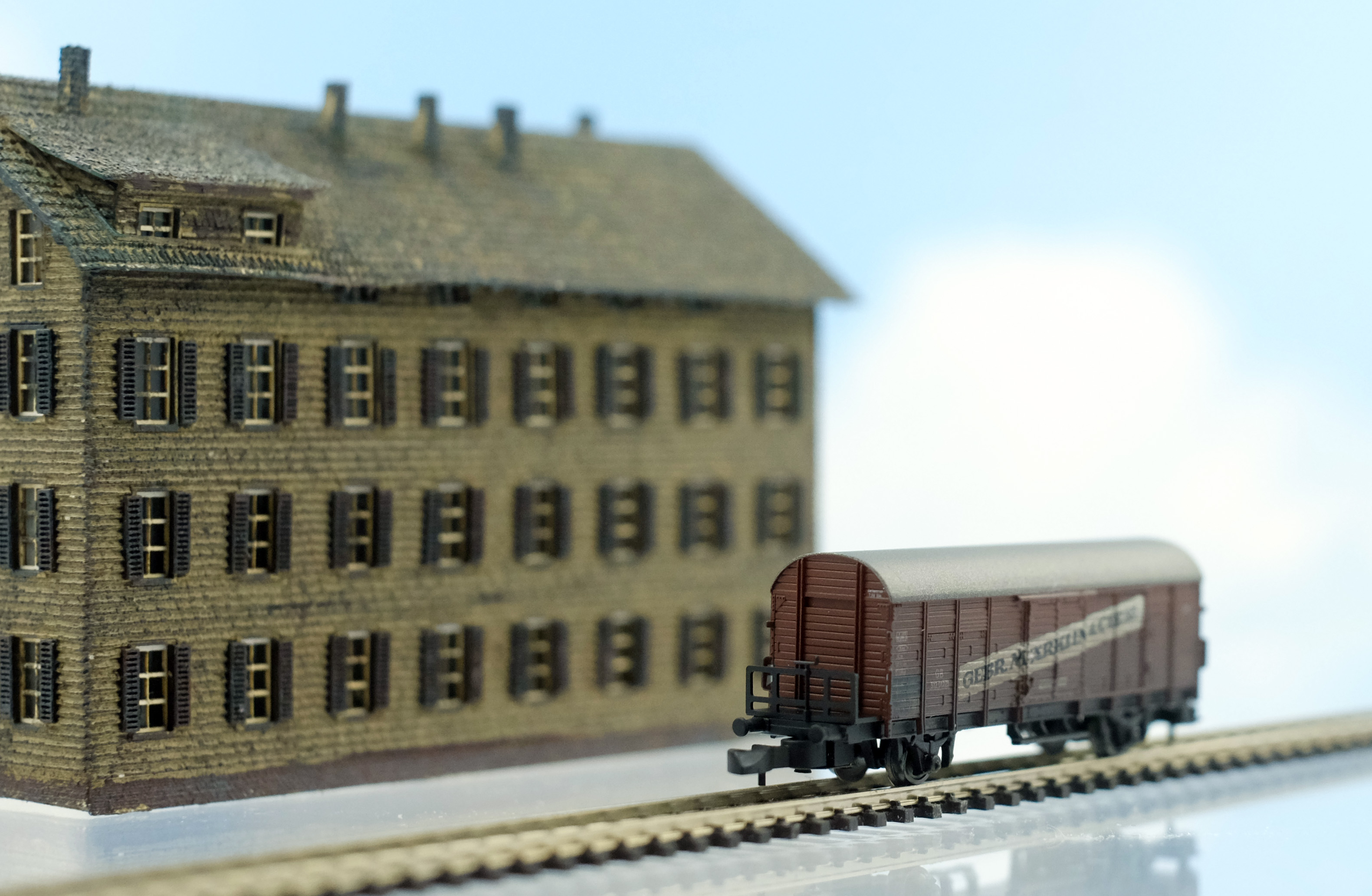
Siding: Faller’s 282781card-stock building is depicted in this post, it includes two kits glued together.
Factory Weathering: Marklin 82267 boxcar

Marklin’s factory weathering doesn’t get any better, and this example is another superb example. Featuring a post on one freight car is worth the effort, single cars can sometimes be overshadowed by the glaring goodness of fancy beautiful train sets and locos in the mini-club program, but individual cars add interest at sidings as they are essential to railroad operations.

Turn this car in the light and depth of detail reveals those qualities such as crisp timber construction, lettering and tiniest bolt heads.

Mated with the early Marklin logo this type GI high capacity boxcar with brakeman’s platform is Era III and weathered to perfection.

Note: The prototype of this Era III boxcar was perhaps loaded with diecast H0 locos and tin-plate rolling stock and other Marklin toys of the 1950’s.

Note: The un-weathered version of the GI boxcar with Era III Marklin lettering was featured as the 2009 Museum Wagen (Item #80020).

Siding: MBZ building kits such as the one featured in this post are available in the United States exclusively from Reynaulds.com. MBZ kits are a bit more primitive and tricky to assemble as compared with Archistories kits which are rigid precise constructions. A natural old weathered look is inescapably linked to MBZ, they are good kits to round out the architecture on a layout or diorama.


Marklin 81699 diesel train set with interesting load

Hardly enough sets seem to have made it to the United States, but for the lucky few the 81699 train set featuring a diesel locomotive and 2 freight cars with loads is another highly desirable version of the V100 locomotive.

Favored by its operators for good handling, visibility, and ease of maintenance, the V100’s side panels were completely removable allowing full access to the motor and components.

Marklin’s “Light Freight Train” 81699 Era III train set is packaged in a small carton with current graphics, it includes the locomotive with operating number V100 2112 and 2 type X 05 freight cars with Tempo Hanseat delivery truck loads. The vans feature metal construction and rubber tires that roll. Locomotive uses the traditional 5 pole motor with brushes, it features LED lighting that change over with direction of travel. Note: prototypical framework holds trucks in place.

A mighty fine design and production makes this and all the V100’s extremely good reliable runners with excellent pulling power. If you need to replace brushes the shell simply pulls off and snaps back in place.

Train can be seen traversing one of the 4 bridges at Hamburg’s Dammtor station released a few years ago as items numbers 89792 (station) + 89793 (arcades and bridges).

Siding: assembling Marklin’s Dammtor station 89792 is fun, it requires many hours to construct, but the completed project is a beautiful. Special note: Dammtor station kit has a 2 layer roof sheathing each piece is only glued to building edges one side at a time and allow to dry. Using glue between the sheets and above the trusses will lead to permanent rippling of the materials.

Marklin 8904: auto set worth considering or reconsidering!

In the program forever maybe (?) is the Marklin 8904 Bausatz PKW (automotive) set. Here is a nice build kit worth considering in the current paint schemes and car types.

Four car types each including 3 of each in various paint schemes. Note: each car type is packaged separately with complementary parts. A simple snap and glue kit of 3 parts for a finished car: shell, frame and glazing. The solid glazing part is sandwiched between the shell and frame after applying two tiny drops of glue, I used Faller Super Expert which is a solvent based glue that dries fast.

Originally designed as an accessory to use on a layout these cars also fill out the load on the auto transport cars including the last release car set 87092 which included 3 auto transport cars DDm 915.

Marklin Autoreisezug 87092

If you need to fill up a parking lot quick this kit takes a little more than a minute a car and includes 12 autos with good detailing. As an added bonus each car can be customized by painting in the bumpers and lamps. Add a white roof to add contrast to the rest of the car.

A real bargain selling for $1.25 a car! Can’t beat that! And will be rust free forever!

Marklin 2017 Toy Fair Loco: E 94 in BLACK: 88228!!!!

The 2017 Toy Fair Loco 88228 is painted and lettered in celebration of Theodor Friedrich Wilhelm Marklin’s 200th birthday. The very attractive release of another E 94 this time with black paint scheme and red handrails based on a fictional prototype. I use the word “another” in jest, one never tires of this electric locomotive with articulated frame.

Presented in a wooden display case the locomotive is further packaged in a box printed with illustrations of Marklin’s historical articles preceding their specialty in manufacturing trains.

Features new generation of brushless motor and LED lighting.


Marklin F7 A-B-A sets: improving performance

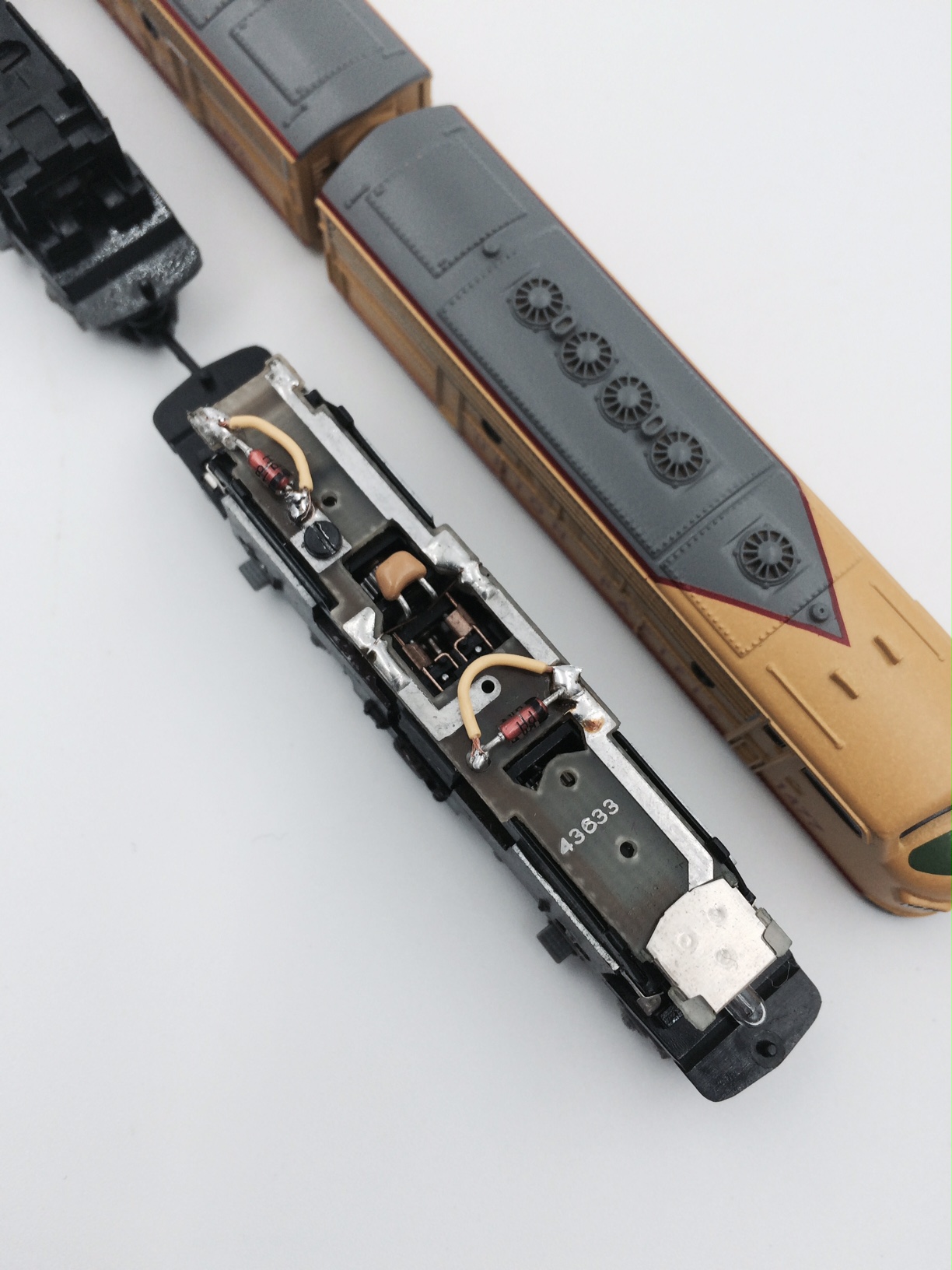
If you are lucky enough to own one of the Marklin F7 sets “Alaska” or “UP” consider this easy repair. Or if you don’t like the wires running through the locos consider this easy repair.

Removing the wires is step 1: cut the wires before removing the shells and carefully remove the wires leading to each circuit board.

Soldering in place four very short wires is step 2: cut 4 small wires to bypass the 4 diodes on both circuit boards and carefully solder the wires in place.

Result: no wires running through the A-B-A units and much improved running performance thus allowing each locomotive to work independently of each other. Note: headlamps will light in both A units at the same time.

Marklin 89982: Turntable with accessories

A number of options exist for buying a Marklin Turntable beyond new and used with dealers offering new old dealer stock of the original turntable alongside the current offerings by Marklin. A release from 2014 included the turntable with accessories as item number 89982, this included 2- three stall loco sheds based on the “New Objectivity” architectural movement and a railway administration building.

Marklin has discontinued the 89982, they are now offering the turntable with controller and transformer only as item #89983, the loco shed building kit is also available as an accessory with item #89835. What is currently not available is the build kit for the railway administration building which is a wonderful example of the Bauhaus architectural style of the early 20th century and is fully complemented by the same era roundhouse. The railway administration building was reason enough for me to buy 89982 which is as beautiful in person as the Marklin promotional photos.

The Railway Administration Building features 2 partition walls, numerous windows and flat roof, its measurements: 7 1/2 inches (length) x 1 3/4 inches (depth) x 1 11/16 inches (height).

Building the kit is easy and straightforward with no issues.

Six stall roundhouse features steel framework and brick infill, it is a very attractive building with rather plain doors that do not swing open and closed with the precision of the Archistories Roundhouse ARC-112121 and accessory Stalls ARC-113121. Interior supports are a bit flimsy and easily bend out of shape, but overall a very good kit that I recommend.

The kit can be built as two separate buildings with 3 stalls each or as one 6 stall roundhouse in which case two exterior walls are omitted, I opted for two buildings.

Unlike the Archistories loco sheds which incorporate 2 part window and door framing with snap in place glazing this kit requires gluing glazing to the interior side of the door. To compensate for the plain doors I decided to age them. First I used a light wash of grimy black (water-based) paint on the interior side of the glazing followed by dry brushing grimy black to doors and brick work around doors, I further lightly aged the bricks along the ground level around the perimeter of the buildings. Light and heavier pressure was used to vary the amount of color to the doors and bricks using dry brush with very diluted paint. Doors readily absorb paint so test a small area first.

Siding: original 3 pole motor turntables can be upgraded to 5 pole with part number 211914.

Marklin Special Imprints: 8600 Series Cars

In the late 1970’s thru now Marklin Special Imprints have been available on a very limited basis. As older collections are dismantled and sold these rarities can only be found occasionally on Ebay. Growing a collection of special imprints takes time and commitment due to their very limited availability, but the hunt is fun! Marklin has continued to produce special imprints cars mostly commemorating train events, but the early cars celebrated a vast array of products and manufacturers with very exciting graphics and always featuring the Marklin “m”. The Marklin “m” on the sides of these cars indicates printing by Marklin versus its omission on privately printed cars known as “Industry Prints” equally rare and sought after.

In the Marklin Special Imprint category is the 8600 type refrigerator car, this car type has been used more than any other for special imprints possibly owing to its smooth sides.

Printed in small numbers these commissions are often limited to 100-200 worldwide with the Swiss Hbis car types printed in editions of 300 and others of 500. A good reference for SMI’s is Koll’s Spezial Katalog 1996 + 1997, both highlight year produced, edition size and value. Pricing SMI’s is tricky business possibly due to their infrequent appearance in the market, but rare items tend to be hard to price in general.

Here are four recent finds on Ebay:

1. NORTHEIMER DIAT PILS, Koll’s #87018 (year produced 1987), edition: 100

2. DAB (Dortmunder Actien-Brauerei) Pilsener, produced in 1998 to commemorate the Intermodellbau ’98 1-5 April 1998

3. Lohrer Bier, Koll’s #88023 (year produced 1988), edition: 100

4. Bad Vilbeler Ur Quelle, Koll’s #88010 (year produced 1988), edition: 200

Siding: Koll’s published 4 books for mini-club collectors: KOLL’S PREIS-KATALOG MARKLIN Spur Z 1996 (standard releases), KOLL’S SPEZIAL KATALOG 1996 (SMI reference book), KOLL’S PREIS-KATALOG MARKLIN Spur Z 1997 (standard releases), KOLL’S SPEZIAL KATALOG 1997 (SMI reference book). The two standard release books are fun to look at, but the ultimate guide for standard releases is COLLECTION Marklin Spur Z released in 2015 by Thomas Zeeb, this book was released in a special boxed edition with the 2015 Toy Fair loco 88422: BR 111 with experimental paint scheme. Note: Marklin loco 88422 was originally released with the book, but it is also being sold now without the book, before you order one ask the dealer if it includes the book.

Marklin 89941 Transfer Table: brief notes on history and repair

First introduced to the mini-club line-up in 1977 the 8994 transfer table would remain unchanged in design until 2002 when it was upgraded with a 5 pole motor and the item number was extended by a ‘1’. From 2003 until 2012 the 89941 transfer table was available with a few packaging changes including white versus blue transformer and controller plus a five pole motor. Manufactured throughout its long history in Italy the transfer table is a very well designed and precision accessory for mini-club, it could be used on a layout for modeling steam and diesel, but it could also be accessorized with catenary for electric locos.

I have seen many early and late transfer tables and all were in excellent working condition owing to the excellent design and manufacturing.

The one and only issue with the transfer table 89941 that is easily overcome has to do with delivery specs, three times 89941 was delivered to a local dealer from Walthers and each was afflicted with the same issue: motor housing top plate separation and subsequently gearing detached along with operators’ cabin. No fear, I was able to easily put each back together again. Probably poor packing and shipping from Walthers to Pennsylvania shook things up a bit, but the problem was easily mitigated, and I wanted to share brief notes on the motor housing for new and old transfer table fixes, repairs and restorations.

The motor housing on the transfer table is easily accessed by slipping off the operators’ cabin and then gently working off the top plate of the motor housing which is held in place by clips. Inside the motor housing three sets of gears and the motor. If you need to remove hardened oil simply remove the vertical gear and top gearing to connects with motor and soak in original (blue) Windex, leave motor and second gear in place and with careful use of toothpick, tweezers and very small cleaning cloth remove dirt and hardened oil from the inside of motor housing. Don’t obsess here, normal loco dirt and debris such hair do not afflict this part, careful not to add lint to the housing by cleaning.

To reassemble the motor housing locate mounting hole for vertical gear in base of motor housing (see shiny brass part with hole in base), worm drive end of gear sits in this hole. Note: worm gears align with regular gears only, they do not function together. Large gear is correctly installed on top engaged with worm gear (bushing on each end of top gear that engages with motor allow it to move freely, double check this gear is properly installed before proceeding). Before attaching top plate locate hole with brass bushing, this hole will align with top of vertical gear. Lastly slide on top plate and test.

Underside of top plate with brass bushing, top of vertical gear sits within the bushing.

Everything fits correctly when the motor housing has no gaps.

Note: bridge only moves with power applied when gearing is properly installed, it will not move freely unless the vertical gear is removed from the motor housing.

Don’t be afraid to buy the transfer table used, I have never seen one that can’t be restored with a simple cleaning or realignment of the bridge and those include some late 1970’s examples.

Good luck and happy railroading. Stay tuned for the next post, an exciting loco shed to go with the transfer table has just been released!

Archistories ARC-104171:

Siding: realistic modeling might include weathering of the bridge and attaching corrugated steel in the form of laser cut cardstock to the roof of the operators’ cabin.

Engineering Perfection: Marklin E 18 in ‘Z’!

I recently purchased a rare variant of the E 18 electric locomotive in Z by Marklin, it arrived as a used working model, but with a fair amount of dirt and hairs strangling the axles. Cleaning it up included taking it apart and removing the dirt and grime under the hood, but it also included removing excess oil that even found its way under the circuit board. No HOS (hardened oil syndrome) to deal with, but over oiling has its issues including attracting dust and damaging the motor, in this case not much damage occurred to the locomotive.

This post is not so much inspired by the normal reporting of mini-club locomotive maintenance instead it is one that was inspired by the brilliant engineering and design of the E 18 for mini-club.

Marklin does not apply the same rules and principles when designing a mini-club loco: same motor and chassis different shell, no Marklin designs each locomotive class from the ground up thereby insuring the prototype is accurate in 1:220 scale and operates as flawlessly as we have all come to expect from mini-club operation!

Marklin 88082: rarest E 18 variant from 2004

The E 18 is an example of one such mini-club locomotive design that incorporates unique engineering and casting that is also meant to be taken apart and repaired when the need arises.

Taken apart this locomotive has a lot of parts that work flawlessly in the assembled locomotive including two gears that sit on posts within the frame and two large gears allowed to float on their axles.

above photo: right- small metal gear sits on post within frame as well as a second one not pictured, 2 additional gears one synthetic with two sets of gearing sit posts that are inserted through frame body

above photo: left- drive wheels that float on their axles pictured left are assembled in slots on the motor end of frame, two drive wheels right use thinner gears that are permanently fixed in the center of axles which are thicker than floating axles.

The design concept is simple: gather electricity from the wheels by way of a circuit board, the turning worm gear (transmission) on the motor engages with gearing that engages all the way down to the wheels thereby making all wheels drive wheels except for the pilot wheels.

Note: plastic mini-club loco shells are removed without damage with super thin synthetic guitar picks, do not use metal screwdrivers famously illustrated in the Marklin instruction manuals boxed with the locomotives.

With the shell off the cast wheel details are carefully pulled off, they are simply held onto the frame with posts!

Circuit board is not held under clips as with other locomotives, and one screw is all that is required to hold it in place.

The motor is screwed to the frame with 2 brackets each installed with two screws. Note: if you are at this point in restoration it is advisable to remove the motor and clean the frame under it. It is also a good idea to test the motor out of the frame, inspecting the brushes is also a good idea at this point.

After cleaning all the gears replace in the frame with the two gears on posts first followed by the large gears (2 gears that are designed to float on their axles are installed on the motor side of the frame, thickness of these axles also match the machining on the frame).

Note: use care to prevent bending of the copper leads on sides of frame.

Final steps: clipping on the wheel detail sections and then shell: Voila!!!!!

Variants of the German E 18 in mini-club:

Marklin class E 18 for DB (88080) Era III:

Marklin class 118 for DB (88081) Era IV:

Marklin class 1018 for OBB (88082) Era IV:

Marklin class E 18 42 for OBB (81441: trainset with coaches) Era III:

Siding: no other Z scale loco is designed to be taken fully apart and easily assembled as mini-club: diesel and electrics are easier than steam and non articulated are easier than articulated.

Siding: all class E 18’s are sold out at the factory, but Walthers still has the 81441 trainset available with beautiful green livery and 4 skirted coaches.