Author Archives: garygraves

Introduction: Marklin’s BR V 160 + 216 + 218 in Z

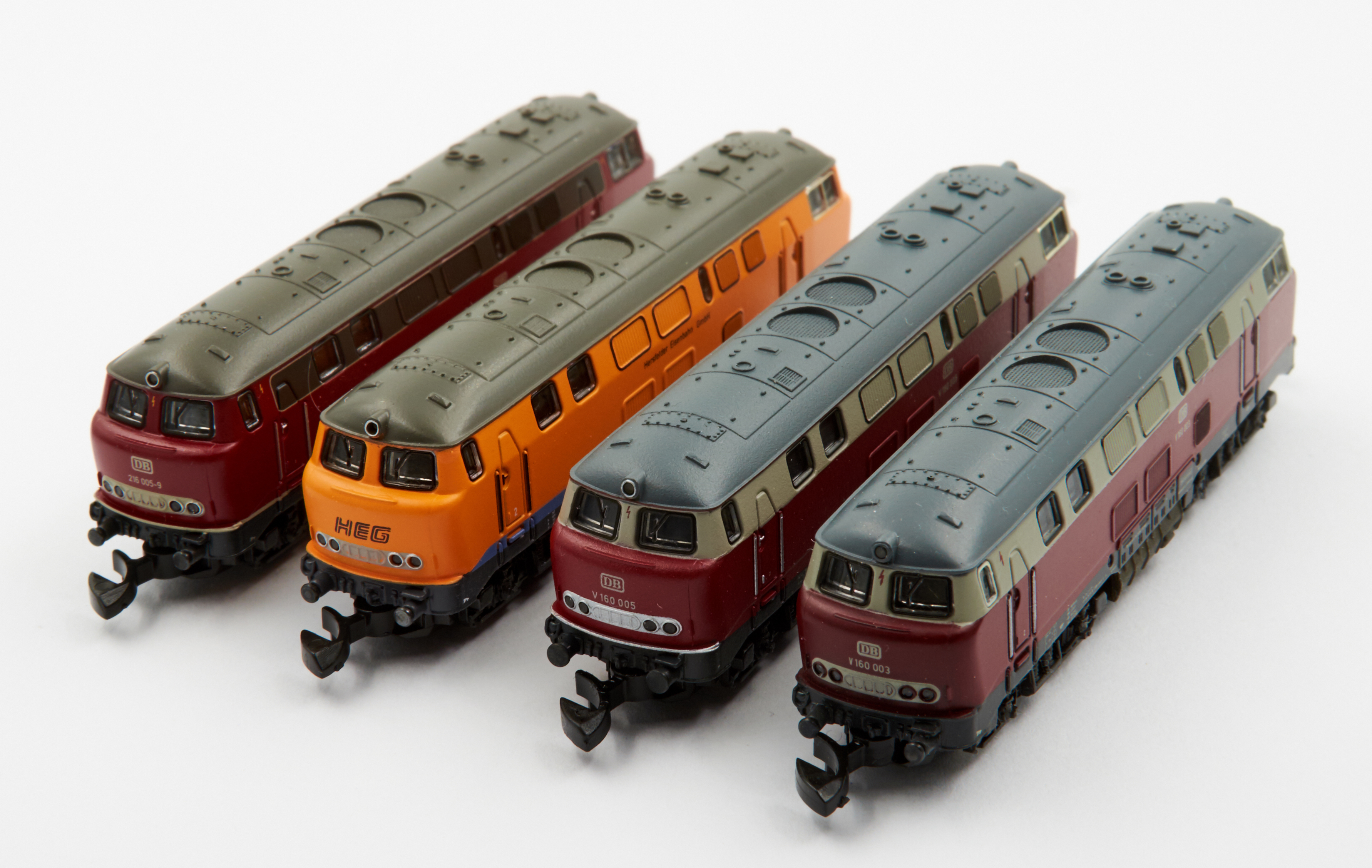
One of favorite Z type locos are the diesels: BR V160, BR 216 and BR 218 and their variants. A technical consideration for railroaders operating a layout of German prototype, you won’t find a better and more satisfactory runner than these with the 3 pole or 5 pole motors, they are perfection and even feature LED lighting with trailing lights to boot. There are real bargains to be had with many of these models on the secondary market, and of course a 5 pole motor upgrade is another consideration that is very easy to perform with this loco type. Overall there are three types that fit this category with sides and paint schemes that boast the obvious variations, but let’s not overlook roof details with variously shaped vents and stacks as well as color changes which yield 4 general variations in this interesting Z group.

_DSF9754

from left to right:

  1. BR V 160 with operating number V 160 003
  2. BR 216 with operating number 216 188-3
  3. BR 218 (without stacks) with operating number 218 320-0
  4. BR 218 (with stacks) with operating number 218 217-8

A close look into the grills and ends of lovely diesel locos starts with these locomotives classes due in part to paint schemes of mixed variety. And private industry offered bit parts in this illustrious history.

_DSF9759

from left to right:

  1. 8866- DB, BR V 160 “Lollo,”operating number V 160 003
  2. 81411- HEG, former BR V 160, operating number BR V 31
  3. 88782- DB, BR 216 (following 1968 German loco reclassification),                                           operating number 216 005-9
  4. 88785- DB, BR V 160 “Lollo,” operating number V 160 005 *note the brighter grill than that of 8866

_DSF9768

5. 88784- DB, BR 216, operating number 216 188-3                                                                                  6. 88783- DB, BR 216, operating number 216 199-0

_DSF9774

7. 81782 (starter set)- H.F. WIEBE, former class 218, privately owned with no operating number    8. 8880- DB, BR 218, experimental paint scheme, operating number 218 217-8                                 9. 88786- DB, BR 218, operating number 218 320-0

_DSF9786

10. 88787- DB AG, BR 218, operating number 218 260-8                                                                         11. 8879- DB, BR 218, operating number 218 104-8                                                                                  12. 8878- DB, BR 218, operating number 218 438-0
 

Marklin weathering: experts in Z!

Marklin has released ‘weathered’ rolling stock before, but the weathering on a current release of 10 cars is so good it deserves special praise. Those 10 cars are none other than the GI 11 boxcars for the DB in three versions: 82175- 82178 type GI 11 without hand brake, 82261- 82263 type GI 11 with brakeman’s cabin, and 82264- 82266 type GI 11 with brakeman’s platform. In 2014 Marklin released these same cars lettered for the DB in a 10 set pack without weathering, they showed off Marklin’s excellence in injection molded plastic; you can see all the bolts and planks that built the prototype along with crisp lettering throughout: car set 82559 is long sold out but some are still available from some of the Ebay listed dealers. The 10 individual cars this post is dedicated to is currently out of production (short shelf life for these beauties!!!), but Walthers still has them in stock! The weathering is coal soot from the loco and other floating dust and grime from many miles traveling the rails. Authentic to the prototype, this weathering is applied to the lower extremities of the cars in varying thickness and spread: no two are the same! I would to see more of Marklin’s obvious weathering skills applied to other locos and rolling stock thus making the world one step closer to being complete and true! Bravo to Marklin!

_DSF9697

Three car types from set 82559 side by side with the newly released heavily weathered same car types.

Siding: wheel sets are also complemented with authentic weathering. Wheel sets from Marklin Z rolling stock can be similarly weathered and aged using an airbrush with water based pigment, they simply unclip from the chassis, hold them in place and give each a light swipe from the airbrush gun!

Marklin Insider Club Membership

Just received my Marklin Insider membership renewal. Prices keep going up all the time, but not Marklin Insider membership which has gone down $10 bucks, it is now $99 a year and includes the club car, insider loco reservation form, and Marklin Magazin and Insider News Magazine subscriptions. You also get the annual catalog. But you also get the DVD’s “Year with Marklin 1 and 2.” I look forward to the DVD’s with much anticipation, the episodes include much background on German rail through presentations of museums, hobbyist layouts , and more. But the ‘Bonus’ track includes cab rides with the latest including a 3 hour cab ride in Switzerland’s “Glacier Express.”

88731 Max Liebermann special repair notes that deserve consideration!!!

The Max Liebermann class 601 special one time series from 1997 is a two locomotive set that deserves a special highlight with regards to any under the hood repair. I just upgraded mine with new 5 pole motors, and it deserves some special considerations before you might consider doing the same. As with others in this series, Marklin continued to make changes and improvements including more durable couplers that allowed less gap between coaches and locos thereby making some parts non interchangeable between the 1st release of this loco type #8873 (DB) and the second release 88731 (DR). Those non interchangeable parts include the circuit boards and couplers all other parts are interchangeable through the series. The first coupler designed for the 8873 was a plastic clip with electrically conductive brass under spring tension, cars and powered end cars were simply pushed together gently until clip engaged with post located inside each car. The 88731 used a new design coupler that was flat with electrically conductive brass surrounding it and more surface area for electric transfer than the 8873. The new coupler necessitated the elimination of the center post in each car end which thereby led to a newly designed circuit board that would accept the newly designed couplers.

Please note before you make the motor upgrade to this set there are two distinguishing  remarks I would like to make that might be helpful: 1. one loco coupler is semi-permanent, it needs to be carefully released from the clip that holds it in place. Use gently pressure to wriggle up the opening in the loco shell and with little pressure slide out coupler. *Other coupler will simply slide out at the normal 90 degree angle that is used to couple cars and locos together in this set.  2. Marklin did not have their heads on straight when they assembled my set, they soldered the circuit board whiskers directly to the motor wires. I am not sure if this was widely done with this set, but this is the first I have seen it. In order to change the motor or do a strip down cleaning and re-oiling 4 solder points need to be removed (2 each powered end car). *Do not attempt to remove circuit board without removing the solder points first, motor is held in place under circuit board mounting plates held in place with 7 screws, it is impossible to remove motor and circuit board at the same time. In order to remove solder points heat them up with iron and pull wires away, remove any roughness of solder left on wires by gently heating residual solder with iron, bend wires back in place to make contact with new motor wires. *The down side to this repair are several opportunities to break parts or melt plastic parts with soldering iron. Not all three pole motors need to be replaced and maybe this is one.

Speaking from experience with a couple of 8873 sets, couplers used in this train work great, I have never had one break or malfunction.

“Good night, and good luck.”  -Edward R. Murrow

“Lollo” that’s the name! or BR V 160 for sure!

“Lollo” is the cutest nickname for a hardworking diesel locomotive, but what’s in the name? The loco was nicknamed “Lollo” as an apparent allusion to the actress Gina Lollobrigida and because of the apparent shapely front end of the loco (?). After a quick google search, I told my Wife about the nickname given to this loco, my Wife rolled her eyes when hearing that a loco would be named after an Italian sex symbol; one wonders what else is named ‘Lollo”?

Thus far to the best of my knowledge Marklin has produced 4 variations of the V 160: 3 individual releases and 1 with a train set. Note: two of these locos were renamed in 1968 following Germany’s new classification thus they are technically BR 216’s.

_DSF9618

from top:

  1. 8866- German Federal Railroad (DB) BR V 160 pre-production general purpose diesel locomotive. Operating number V 160 003. Era III (1962). Originally sold with 3 pole motor. Build date: 1990-1994.
  2. 88785- German Federal Railroad (DB) BR V 160 pre-production general purpose diesel locomotive. Operating number V 160 005. Era III (1962). Current catalog.
  3. 88782- German Federal Railroad (DB) BR 216 005-9 former BR V 160 reclassified in 1968 as BR 216. Operating number 216 005-9. Build date: 2005-2008.
  4. 81411- HEG – Hersfelder Eisenbahn GmbH privately owned former BR 216, operating number BR V 31. Sold as part of train set 81411 which included loco and 4 hinged roof hoppers. Originally sold with 3 pole motor. Build date: 1997. One Time Series for MHI (Marklin Handlers Initiative).

_DSF9728

Photo: the new “Lollo” with bright new grill is second from right!!!

*Note: LED’s on all these locos with warm white and red lamps that change over with direction of travel. Great feature found on all versions of this loco type even with the early ones!!!!! And they are superb runners!

Siding 1: 8866 and 81411 can be upgraded with E211903 5 pole motor.

Siding 2: check out the cool elliptical window that disappeared following modifications to the V 160.

Siding 3: In 1968 the V 160 was reclassified as BR 216, V 162 became BR 217 and V 164 was reclassified BR 218. A very informative Wikipedia page is dedicated to the V 160 that fans should check out.

What was once is here again: 8866 + 88785

The ‘pre-production’ 1962 BR V 160 “Lollo” was released as Marklin 8866 in 1990-1994, here it is again as 88785 with the recent release. Class 160 was an important locomotive development in Germany thereby creating a successor to steam unmatched by other locos at the time. Germany’s new classification of 1968 renamed it BR 216, by then it had also undergone a transformation which will be presented in other posts.

_DSF9612

from top:

8866- German Federal Railroad (DB) BR V 160 pre-production general use diesel locomotive. Operating number V 160 003. Build date: 1990-1994.

88785- German Federal Railroad (DB) BR V 160 pre-production general use diesel locomotive. Operating number V 160 005. Build date: current catalog.

Variations in the Marklin models are subtle:  Paint maybe a little brighter (?) on 88785, door numbering is smaller on 88785, frame no longer says ‘Made in West Germany’, electrical equipment insignia has been removed from side panels on 88785, door latches painted on 88785, bright silver grills on 88785, different operating numbers, wheels darkened on 88785, and 5 pole motor is standard with 88785.


Siding 1: 8866 can be easily upgraded with 5 pole motor #E211903.

Siding 2: All variations of V160, BR 216 and BR 218 have always used LED’s thus warm white and red lamps that change over with direction.

Marklin: Maintenance of Way

Marklin’s ‘maintenance of way’ rolling stock and locos is an ever expanding area of collecting including regular releases and limited ones. The daily respect and observance of track, roadbed and signals is an experience we have in common at least keeping track clean for good electrical contact. Railroads around the world perform various levels of maintenance some more than others. Incorporating some of these interesting locos and rolling stock in a layout further represents what railroading is all about, maintenance is key to everything running smoothly in scale or prototypical operation.  This is a very interesting topic for collectors and a number of manufacturers produce some great items including Railex and FR. Check out their sections on this blog. And definitely take a look at FR’s website which seems to include several examples of MOW vehicles from SJ and SBB including a snowplow loco coming up!

_DSF9607

  1. 87741- German Federal Railways (DB) type ‘fast measurement’ coach lettered “Messwagen Versuchsanstalt Minden”. Limited European release.

_DSF9603

2. 8657.H.F.WIEBE- ‘MSI’ (Marklin Special Imprint) type Krupp-Ardelt crane car and low sided flat car with boom rest lettered for H.F.WIEBE. Car set originally sold with train set 81782 in a limited number of 500. Produced for Conrad Electronic.                                                                      3. 8657.3- German Federal Railroad (DB) Era IV type Krupp-Ardelt crane car and low sided car in yellow with boom rest (Version #3) produced 1991-2008. *two versions proceeded this version with color variations                                                                                                                         4.86571- German Federal Railroad (DB) Era III type Krupp-Ardelt crane car and low sided car with boom rest.

*Note: a single type Krupp-Ardelt crane car with boom rest was released as 8621 in three blue color versions, it was produced 1986 – 1987. All crane cars have working crane, pivoting boom, and swivel cabin.


Next generation of mini-club box?

_DSF9646

I just received the latest BR 212 diesel locomotive, it arrived with a brand new box design. Is this the start of a new box for mini-club? Going from the previous black to predominately white box with new graphics is a nice departure from the former. This will be the fourth generation of mini-club box since 1972 with the ‘wood grain’ design fold-out display box followed in due course by the brown photo illustrated box that was out for many years. The third of course is the black box roughly corresponding to the transition to 5 pole motors, roughly corresponding because the first loco with a 5 pole was the newly tooled DB class 143 released in the characteristic brown box,  it would be a year or two before the black box arrived but close enough to signal the new direction for mini-club. Now a new box coming at a time with the advent of new motors, enhanced retooling of locos including increased detail and action of steam loco side rods, and of course the many newly designed locos and rolling stock ! An infusion of excitement is unfolding and the new box maybe signalling a new future for mini-club!

Featured: Marklin Z 88216


Coreless motors in Z: Should Marklin move to this new technology?

Coreless motors have taken ‘Z’ by storm. The successful use of these new propulsion systems are used in locos designed for them. A few conversions are now available for Marklin F7’s for a price, but successful conversions of these motors in traditional Marklin Z frames will be for another discussion. Locos designed for coreless motors come from the workbench of Harald Freudenreich at FR, Harald has very successfully created beautifully tooled locos using coreless motors for a number of years now. Characteristics of coreless motors are very good propulsion at low speeds and completely quiet with added weight to assist with better movement on the tracks as well as pulling power. Marklin has gotten into the act offering some new locos with coreless motors, but these have not made it to general release yet. A few questions arise concerning Marklin’s foray into this new technology, and if they should incorporate them into Z trains. At the heart of the question is an already very successful history with their 3 pole and now 5 pole motors that have proven themselves for 40 plus years. I like the hum and glow of Marklin mini-club motors, but the design perfection of Marklin mini-club is furthered by the ease with which most can be maintained, that could get lost with this new technology.

I will close with that old adage: “If it isn’t broken why fix it?”


Upgrading 8856 to 5 Pole Motor

Just a few notes and highlights about upgrading the motor for 8856 ‘Krokodil’. The 5 pole motor is currently available from mostly German dealers on Ebay, it is part number E211904. There are a couple of pitfalls and things to be aware of before you decide to make the repair. First is the rather awkward nature of the design of this loco, it uses a very small circuit board which thereby requires six wires to be soldered from it to the articulated frames, being that there is little room under the hood and the wires maybe 30 years old resoldering some maybe required!

Getting started: After the cabin and hoods are removed the circuit board is unscrewed (2 screws) and the pins removed from the wheel frames. BIG NOTE: 2 rubber washers are located between circuit board and motor frame, be careful not to lose these tiny parts after unscrewing circuit board! Motor frame is thus free from the loco and motor can be easily replaced with the new one, but first the new motor needs to be prepped; bend capacitor so that it is level with rest of motor (it is delivered with the capacitor bent upwards), the capacitor will rest under circuit board and above worm drive (this makes sense when you see it). Use great care putting the center frame back in place, the objective is to not break any wires. Don’t forget to put those rubber washers back in place. Wa lah!!!

Enjoy a much quieter “Krok”!!!!