Here is a build kit suitable for Germany and the United States. Released in 2019, Marklin 89758 is another laser-cut cardstock building kit based on a fish belly bridge. Such a design allows for very heavy freight trains, in the United States Lehigh Valley Railroad built a steel fish belly bridge in 1901, it connected Easton, PA and Phillipsburg, NJ. This bridge is now abandon, but its original purpose was transportation of very heavy freight trains hauling coal. Interesting to note: this bridge was built on piers built in 1866, it stands today far outliving its useful life.
Marklin’s 89758 is described in Marklin literature as similar to one historically protected in Plettenberg, Sauerland, Germany.
The bridge model represents a steel bridge with quarried stone piers. It measures: 8 5/8 inches (length) X 1 1/8 inches (width) x 1 1/8 inches (height). The build is straight forward comprising precision parts that fit together without modification thus a very fine kit. My only criticism for the kit is a limited number of gusset plates. I may opt to use paint with dry brush and/or air brush for an added layer of weathering perhaps making the bridge look for ‘steel’ like.
Readers of ztrainsweekly know of my interest in FR’s (Harald Freudenreich) Z gauge model trains thru many posts since its start. Lately the brand known as FR Freudenreich Feinwerktechnik is today Atelier Barkvieren. Over the course of its beginnings in the early 90’s FR’s contribution to the hobby includes just over 800 items, its history and reputation rooted in highly precise prototypical accuracy and flawless design + manufacturing. I thought it would be interesting to look back at a model train set produced in 1994 by Harald Freudenreich, and the fourth item ever to be produced in Z by FR.
Known as article number ZF004, it was preceded by 3 other train sets all from 1994 (numbered respectively ZF001-003). Today the discussion is about ZF004 train set painted and lettered for Lehigh Valley Railroad (1846-1976).
Train set ZF004 (1994) limited to 50 sets included a AGEIR boxcab diesel locomotive and 3- 31′ fishbelly hoppers painted and lettered ‘LEHIGH.’ Locomotive is constructed of metal with maintenance free motor similar to ones used by Marklin today. Locomotive is heavy as it appears to be entirely made of metal including truck frames and brass securing screws. Add-on parts include roof details: brass bell and smokestack. A curious characteristic about the loco are the non-rotating wheel sets, but loco’s short wheelbase allow it to negotiate curves perfectly, plus each truck includes pair of freely turning wheels without flanges thus locomotive includes 2 sets of driving wheels and 2 sets of un-powered wheel sets. FR’s distinctive coupler design was already used on their first locomotives as they are unchanged to this day. Couplers comprise simple bent wire hooks which couple easily with Marklin mini-club couplers, they also do not detract from the locomotives prototypical appearance.
Hoppers are constructed of mostly metal with fine detailing, each features prototypical couplers except for lead hopper numbered 25617, it includes a Marklin coupler at one end to pair with simple wire hook style coupler on locomotive. Hoppers appear to have 2 add-on parts: handbrake and platform by handbrake. On the underside: truss supports and coal funnels appear to be cast plastic cemented in place. Wheels are black plastic with each wheel set attached to car with brass screws. Each hopper features sharp lettering with smallest lettering perfectly legible with magnifying glass. Hoppers numbered: 25617, 25322, and 25039.
Train set was delivered in wood display box as was 4 other train sets in 1994. Display box is lined in silk and features metal ‘FR’ logo. Wood display boxes were used over the years by FR each lined with silk. This set as I bought it does not have additional items such as descriptive booklet, I am doubtful one was included. The presentation elevates this train set to the ‘expensive’ item category which in 1994 carried a price tag of 875 Deutsche Marks.
Siding: What’s in a name? ALCO Boxcab diesel locomotive was a diesel/electric switching locomotive referred to as AGEIR Boxcab’s so named after an amalgamation of the 3 builders of this locomotive class: ALCO (American Locomotive Company), General Electric and Ingersoll Rand.
Marklin baggage car 86061 is loaded with detail. As Marklin’s description notes: it does not have a cupola which is pretty obvious. It features extensive lettering, metal wheels and plastic shell. Identified as type Pwgs 041 Baggage Car, it is painted and lettered for German Federal Railroad (Era IV).
Marklin 86061 Baggage Car Type Pwgs 041Marklin 86061 Baggage Car Type Pwgs 041Marklin 86061 Baggage Car Type Pwgs 041
A freight car so rich in details it deserves its own post. And its still floating around at the dealers, but out of production at Marklin.
Marklin 86061 Baggage Car Type Pwgs 041Marklin 86061 Baggage Car Type Pwgs 041
Marklin recently released a large set of freight cars (82641) for global shipping theme (Era VI), it includes eight type Sgns 691 flat cars with tank and dry storage containers. Various railroads and shipping companies represented in the set are colorful and graphically interesting.
82641-0882641-0882641-0782641-07
The release comes boxed in what Marklin calls a display box, it is intended as counter display for dealers who may opt to sell individual cars from the set. Marklin produced large car sets in the past thereby giving customers flexibility to buy 1 or all cars from the sets. With one local exception USA dealers have offered complete sets only. Cars in the set are each housed in familiar Marklin Z hard plastic boxes, and each is assigned a number 82641-….. (01-08).
82641-0682641-0682641-0582641-05
Flat cars are manufactured with the relatively new technology: metal impregnated plastic. Increased weight is the primary benefit thus better running performance, and maybe casting detail is improved. Car bodies are superb, they feature open frames with extensive fine paint and lettering.
82641-0482641-0482641-0382641-0382641-0282641-02
Containers are of great variety, but they are the typical containers Marklin has offered before: open bottoms with no prototypical lettering on doors, but very fine lettering otherwise. Tank containers with protective frames are standard fare offered before, tanks are finely painted and lettered, but protective frames which are manufactured apart from tanks and assembled later may need removal of excess plastic. Six tank containers are included, 3 in my set had issues: 1 missing mounting pin, 1 needed plastic trimming around pins to mount and 1 needed trimming/leveling of plastic base otherwise it wanted to pop off. Repairing tank containers took no more than a minute thus no big deal. Note: no problems whatsoever with dry containers. Further comment on tank containers: mounting has always been an issue with some collectors opting to cut off pins and epoxying the tank containers directly to the flat car. I do not recommend gluing, instead I recommend very carefully removing extra plastic in casting with a razor blade. Except for lack of graphics on doors of dry containers and mounting pin issues with tank containers this is a very good set to add to your collection.
82641-0182641-01
Siding: Released in 2024/25. Marklin suggests locomotives 88136 (diesel Ludmilla) and 88235 (electric Vectron) for freight set 82641.
A New Year and a new series for Marklin Z scale enthusiasts: “Pantone Color of the Year” freight cars. So far 2 cars have been presented coinciding with Pantone’s annual celebration “Color of the Year”: ‘Viva Magenta’ (2023) / ‘Peach Fuzz’ (2024).
Marklin 82164: 13-1023 Peach Fuzz
Pantone Color Matching System has been used widely by graphic designers and those in the print industry for 60 years. Developed from 18 basic colors each numbered and titled color can be faithfully reproduced using Pantone Matching System (PMS).
Marklin 82163: 18-1750 Viva Magenta
Pantone’s importance to the print industry perhaps inspired this new series. And maybe links with Marklin Magazin releases (2001 – present), it too makes reference to the print industry. And the unmistakable “Prussian Blue” painted freight cars and steam loco released in the series.
Marklin 82164: 13-1023 Peach Fuzz
Pantone describes Viva Magenta (2023): “….a pulsating color whose exuberance promotes a joyous and optimistic celebration….” And Peach Fuzz (2024): “It’s a velvety gentle peach tone whose all-embracing spirit enriches mind, body, and soul.”
Produced in HO as well as Z this new series is a “One Time Series.”
More than 8 years ago I shared a short post on the Railex Auto Transport Set for Lötschberg Tunnel. Today I revisit this set with an expanded post partly as tribute to 2 companies that cease to produce items for the Z Gauge Modeler: Railex and Z-Modellbau. Both companies expanded an idea: “What’s possible in Z?” Precision and execution of prototype accuracy has been the mission of both companies.
Z-Modellbau #3107 painted and lettered for the firm Vanoli is not associated in real life to the Lotschbereg Tunnel, but it is Swiss so therefore I use it for scale. The prototype locomotive for the tunnel is the BLS class Ae 4/4. Electric locomotives are used throughout Switzerland with countrywide limits on emissions: in Switzerland trucks are transported by rail.
Note: So far only Shapeways offers a Z Gauge class Ae 4/4 by Swiss Z Scale Models (Julian Ryf). Not to digress I will follow-up soon with a posting on my experience with printed Z models from the Shapeways platform.
There is little known about the company Railex except they were a German firm and one of the first to make precision Z scale locomotives and rolling stock, Railex was a company offering something else in Z. Marklin invented the scale and covered the gauge by offering electric, steam and diesel locomotives plus numerous accessories and well designed track sets which could be expanded, their unballasted track remains the benchmark for many modelers today. After more than 10 years, Marklin’s new gauge inspired a new company, Railex offered precision unpowered metal locomotives made of brass and nickel plated parts. And presumably a lot more expensive than Marklin. The unpowered locomotives could be powered by ‘ghost’ cars: motors hidden within box cars or coaches. I am not sure how successful ‘ghost’ cars were or if Railex manufactured them: were they after market retrofits? I don’t know the answer, examples I have seen over the years were non working and not identified. Today we know Railex by their products produced many years ago: their surviving legacy. And although most Railex locomotives and rolling are based on early German rail history today’s example is based on auto-transport cars used at the Lotschberg Tunnel in Switzerland. Along side my photos of the models please compare online photos of the trains operating today. Plus someone generously provided a movie.
Detail: 3 position coupler/draw-bar to allow wider gap between cars (Railex Autotransportzug (BLS) + Z-Modellbau Vanoli-Kof Schweiz (3107) + Marklin 8904 Autos)
Railex Autotransportzug is comprised of 5 cars: 2- open deck cars and 3- cars with roofs. Brass and stainless steel make-up the ingredients of these models, and the set utilizes a draw-bar coupling with 3 positions. The draw-bar is easier to use and operate than it appears, and the coupling is secure. Cars utilize a highly detailed filigree framework which demands delicate handling, but the parts are robust: not prone to bending unless roughly handled. And not for children!!! Signage is installed on the prototype at eye level and further up near framework for roofs, these signs are also installed on the Railex cars not that they can be easily seen which is interesting. Knowing all details are present on the Railex cars kind of completes the accurate portrayal of the prototype even if these details have to be sought out to see. I bought this set more than 20 years ago thus it was secondhand, it was delivered in a long black box with Railex sticker, set did not include cars. I used Marklin 8904 autos for the photos which is a great collection of 12 cars to assemble and glue. As a freight car set this is one of my favorites and one to look out for.
Railex Autotransportzug (BLS) + Z-Modellbau Vanoli-Kof Schweiz (3107) + Marklin 8904 AutosRailex Autotransportzug car detail: extensive prototypical signageRailex Autotransportzug car detail: extensive prototypical signageRailex Autotransportzug car detail: classic Railex logoRailex Autotransportzug car with open deck for autos or high roof vehiclesRailex Autotransportzug car detail: stainless steel road bed with simulated timber car deck
Stainless steel roadbed sits atop suggested timber car floor. Note: stainless steel roadway was originally attached with double-stick tape, more than likely one or more will be pulling up from car body, my best suggestion is removing the entire loose section and scrapping off residue glue which will make part go flat instead of curling plus it will form a more permanent bond.
Z-Modellbau and its owner Dr. Andreas Scheibe produced the finest small locomotives for Z, he was unsurpassed by any manufacturer for the gauge. Dr. Scheibe has retired and his catalog of 45 distinct locomotives will be marveled at for many years to come. Z-Modellbau locomotives are powered by a maintenance free motors, they are highly detailed cast metal with very fine paintwork and lettering. Most of the locomotives are based on German prototypes, but other railroads are represented in his electric and shunting locomotive range including OBB, SBB, CFL, NS, NSB, and Banverket. Lacking electric lights, headlamps are suggested only but hardly noticeable. All of my Z-Modellbau’s were purchased from Quality Toy Trains in Napa, CA, but they could be purchased directly: made on demand with months to wait for delivery. No limitation was applied to production, but models are likely very small in number. Since operations ceased a used model sold for 3 times its original purchase price, but I won’t list values and prices since that is not the aim of my blog. I can’t think of a more valued company to the hobby of Z railroading than Z-Modellbau.
Z-Modellbau (Dr. Andreas Scheibe) Vanoli-Kof Schweiz (3107)Z-Modellbau (Dr. Andreas Scheibe) Vanoli-Kof Schweiz (3107)Z-Modellbau (Dr. Andreas Scheibe) Vanoli-Kof Schweiz (3107)Z-Modellbau (Dr. Andreas Scheibe) Vanoli-Kof Schweiz (3107)Z-Modellbau (Dr. Andreas Scheibe) Vanoli-Kof Schweiz (3107) + Marklin “Administration Building from Set 89982 + Marklin “weathered funnel flow car: wascosca” (82482)
Bringing examples together from 2 of the great manufacturers of Z is due no only to my passion for these articles, but Railex and Z-Modellbau’s key participation in the history of Z scale railroading.
I plan to spend a little more time with this model in a future post, but for now I am sending a shout out to anyone interested that now is the time to track one down even if you have a preorder for it.
Marklin 88146 (released 2021)
In October (2021) Marklin sent a letter to dealers announcing a limited release of this model, they further explained the release would be smaller than anticipated and not all customers with preorders would receive one. I am one such customer thus when one became available on Ebay I ordered it. Some models might still be available through Marklin’s USA Dealer network or German dealers on Ebay.
Note about the model: small steam powered locomotive with passenger compartment based on the Era II prototype with paint and lettering for the German State Railroad. Manufactured in China, Marklin 88146 is a companion to the earlier release 88145, both are similar in appearance with the exception of paint and lettering, add-on parts and mechanism are identical. Collectors sometimes comment on Chinese manufacturing as a problem, but every add-on part which there are many was individually applied. And this level of production with a Marklin Z release is usually well done in China. “Usually” is the word of the day: my first 88146 was missing the left hand side rod, my second one was missing the add-on part installed behind left cab window. Both defects are covered by Marklin’s 2 Year Warranty, but I will be without this locomotive for quite some time.
Paint, lettering, and details are finely produced on this model, it is a perfect locomotive to feature in a small railroad perhaps in a country setting too! It could be conceived to be a railcar propelled with steam propulsion, this all-in-one locomotive with passenger compartment can be hitched to a coach or freight wagon as the prototype required. Two Nuremberg Toy Fair cars from 2008 and 2017 complete the train each commemorates German Railroad history. The 2008 Toy Fair car painted and lettered for the RHEINGOLD train, and 2017 Toy Fair Car commemorates the 60th anniversary of Trans Europ Express.
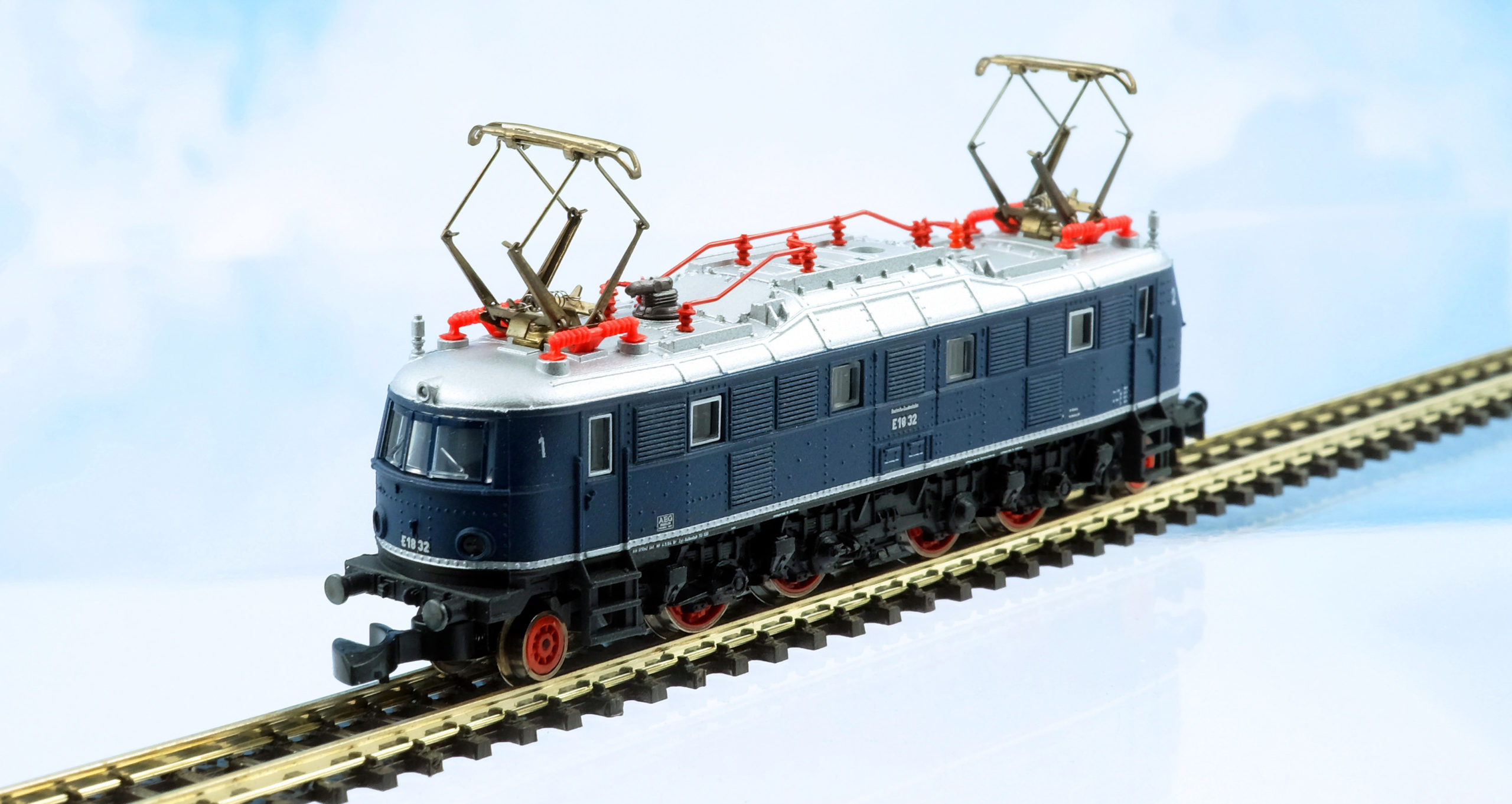
Noticeable differences apply to Marklin’s Era III Class E 18 electric loco both on the outside and inner workings.
The Class E 18 electric locomotive was designed for express train service, it was built over a 20 year span starting in 1935 in Germany and Austria. Although it was designed for express train service it subsequently became an important general purpose locomotive. Marklin’s 88080 and 88088 are based on post war (Era III) prototypes.
Marklin 88080 was released in 2002, it stayed in the program until 2008. This attractive locomotive was the first mini-club Class E 18, its features include 5 pole motor and LED headlamps.
Marklin 88080Marklin 88080
The recent release 88088 features a new motor designed to be maintenance-free: no longer are worn brushes changed out as was the case with the earlier 3 pole and 5 pole motors. The paint scheme is similar for both locomotives, but paint sheen varies: 88088 is matte (prototypical?), and 88080 is glossy which gives the paint an appearance of more saturation and maybe bluer looking.
Marklin 88088
Both generations of the E 18 are good runners with the 88088 running a little quieter and better at slow speeds. It should be noted that earlier versions of the E 18’s performance are exceptional: in my opinion no great improvement between the new release and the older versions, I don’t think a trade-in of the old for new is warranted: save your money for other new releases (?). Perhaps others may feel differently, but I have felt since its release in 2002 the 88080 ran superbly, and I still do, including all the various releases since 2002.
How do they look? Paint scheme of 88088 maybe more prototypical (?). Paint is brighter on the 88080 due to its gloss finish.
Marklin 88080Marklin 88088
Siding: releases of the E18 have included a bright pink/red instruction sheet placed over loco in box with instruction to store loco in box with pantographs fully extended thus to avoid breakage of the delicate roof details and wires rendered in plastic. This loco did not include this warning slip, but it is advised to store your loco with pantographs up!
Rural scenes for Z gauge are just one category of MBZ offerings. Another is railway buildings. For this post I am including examples of both. Plus the Marklin tank locomotive and beer car from starter set 81567 (2003- 2008).
Dealer inventories of MBZ Z scale kits are sporadic, Reynauld’s of Illinois seem to be MBZ’s exclusive dealer in the United States, but their inventories of the kits always run few in number even before the pandemic affected shipping from Europe. I have never had a problem ordering an MBZ item, they each have arrived eventually even the back-ordered ones. And patience pays off as nothing compares to MBZ.
The pros and cons of MBZ kits has been covered here before, and I would be remiss to recommend them again without those comments in case someone new has come across this post. Cons: MBZ kits are a bit primitive, cardboard warps easily, kits can smell burnt when they are removed from packaging, parts sometimes need extra cutting to remove from sheet, and sometimes parts are missing. Note: kits can be a struggle to assemble, and they require problem solving along the way. And some parts easily deform. Pros: after the kits are put together and painted they look great: “from another time”. And that is to say the buildings look authentically old.
A few general instructions: always prime every part before assembly with MBZ’s primer, this step will control the later saturation of paints plus strengthens the cardboard material. MBZ pigment paints soak into the cardboard, but the color can be built up with additional layers. Note: highly recommended to follow MBZ’s painting instructions. Don’t expect precision, it is best to give yourself over to messy and inconsistent paint application. Detail work can be done as the last step with traditional acrylic model paint for moldings and architectural details.
Here are the buildings I picked-up from a recent trip to Reynauld’s, barring duplicates this is all they had to offer me on this trip.
Train Attendant’s Hut (MBZ #16 016): 3/4 inch (height) x 9 1/16 inches x 3/4 inches. Paint: MBZ pigment paint 46 200 with charcoal dust: dry and wet application.
MBZ 16 016MBZ 16 016
Machinery Shed (MBZ #16 063): 3/4 inch (overall height) x 1/2 inch x 3/4 inches. Paint: MBZ pigment paints 48 600 and 40 723
MBZ 16 063MBZ 16 063
Framework Barn (MBZ #16 165): 1 5/8 inches (height) x 1 1/2 inches x 1 3/4 inches. Paint: MBZ pigment paints 46 280, 40 723, 40 612, 48 600, and 40 020
Barn (MBZ #16 087): 1 9/16 inches (overall height) x 1 3/8 inches x 2 3/4 inches. Paint: MBZ pigment paints 46 280, 48 600, 40 723, and 48 060
MBZ 16 087MBZ 16 087MBZ 16 087
Massbach Train Station (MBZ #16 140): 1 1/2 inches (height excluding chimney) x 2 inches x 3 9/16 inches. Paints: MBZ pigment paints 47 150, 48 600, 40 612, 48 060, 40 723, 40 020, and green acrylic modelers’ paint (Testors)
MBZ 16 140
Putting the buildings together with Marklin starter set 81567 (2003 – 2008) are its locomotive and beer car. Originally this set was sold with an oval of track (1 X 8590, 1 X 8500, 4 X 8520, 6 X 8521), mini-club white transformer, red plastic re-railer, class 74 tank loco, refrigerator car painted and lettered for GANTER Bier (1865 – present), and gondola with present load.
Marklin BR 74 (74 701) loco and Ganter Bier Car, MBZ 16 087, 16 165, and 16 016Marklin BR 74 (74 701) loco and Ganter Bier Car, MBZ 16 165Marklin BR 74 (74 701) loco and Ganter Bier Car, MBZ 16 063 and 16 016Marklin BR 74 (74 701) loco and Ganter Bier Car, MBZ 16 087 and 16 140Marklin BR 74 (74 701) loco and Ganter Bier Car, MBZ 16 087 and 16 140
Few Notes on Construction: -Massbach Station (16 140) was missing parts to complete foundation on freight depot, but easy to come up with a solution: left over parts in the kit painted to look like stucco masonry
-barns feature beautiful interior details that are best finished before kit is built
-instructions sheet shows opposing wall part flipped, this will make sense when you look at the instructions for the first time: a bit misleading! CAREFUL!
Marklin’s recent release Era II freight sets include 2 for the DR: 82327 + 86010. Each is identified as Deutsche Reichsbahn thus Era II freight sets. Cars from 86010 are based on an earlier car type from Era I, prototype used on the K.Sa.St.E. B. (Royal Saxon State Railways- Königlich Sächsische Staatseisenbahnen) and released as Marklin item #8601 (1991-1998). Set 82327 features O 10 gondolas released many times before in sets and individual releases including 82322 for the DB (1997-2001).
Marklin 82327 (2021)
Set 82327 is a unique release because of 3 details: paint and lettering for the DR, Tempo A400 Delivery Van and light weathering suggestive of dirt/grime kicked up from track. The Tempo van is cast metal featuring rubber tires that rotate and prototypical paint scheme from the late 30’s.
Marklin 82327 (2021)Marklin 82327 (2021)
Set 86010 features 3 type K Wuppertal gondolas each equipped with 6 hatches that can be opened because of course each is hinged. Bold lettering for the DR contrasting against brown paint scheme.